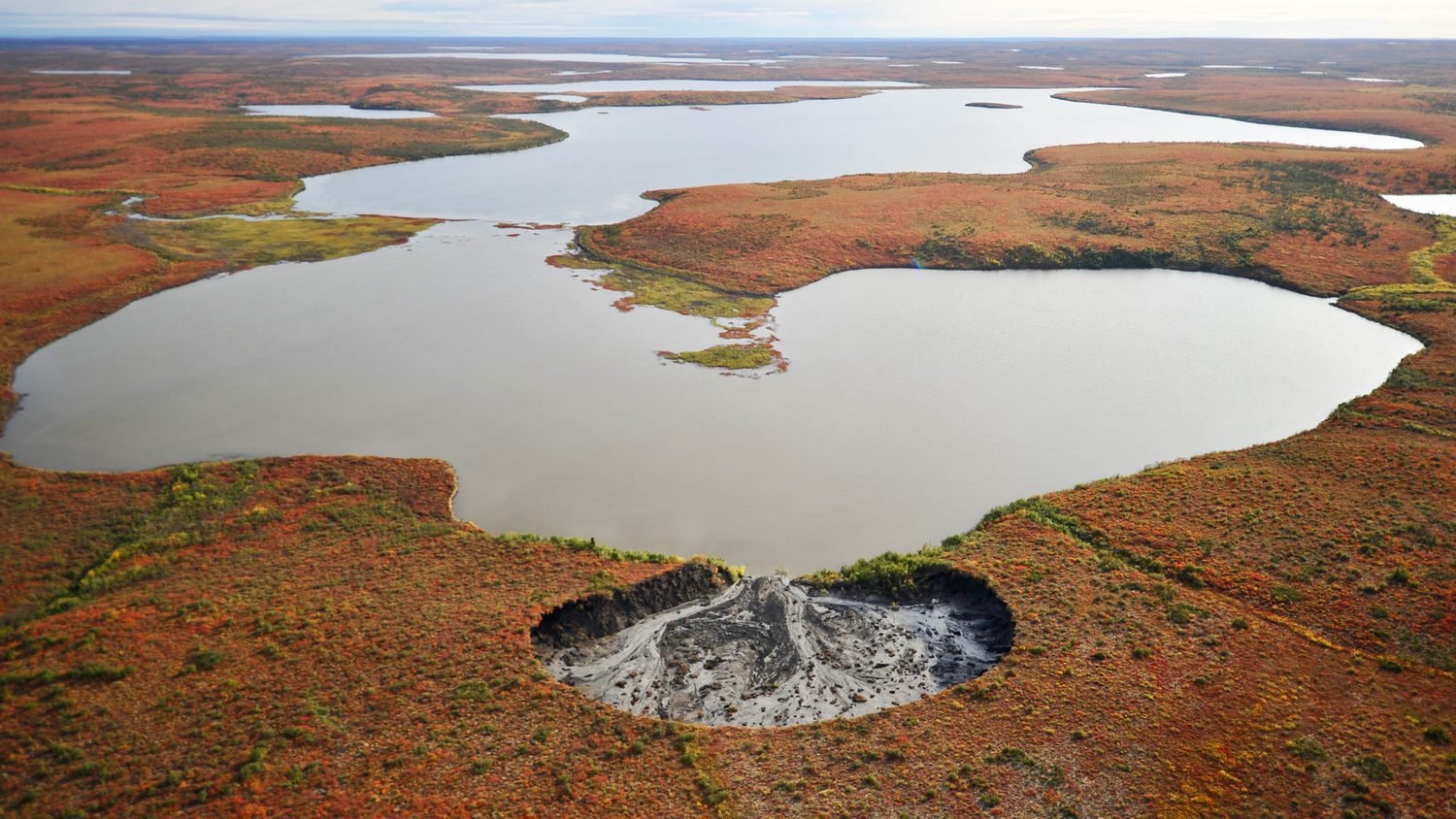
A new study suggests northern Alaska is sending more freshwater and more long-frozen organic carbon into the sea as the ground warms and thaws. Led by researchers at the University of Massachusetts Amherst and published in Global Biogeochemical Cycles, the work offers an unusually detailed look at how rivers on Alaska’s North Slope are changing as permafrost loses its grip on the landscape.
That matters well beyond Alaska. Permafrost stores enormous amounts of ancient organic matter that has been locked in frozen soils for centuries to millennia. Once thawed, some of that material can be washed into streams and rivers as dissolved organic carbon, or DOC, where microbes and sunlight can begin breaking it down. Some of it eventually reaches the Arctic Ocean, where it can be transformed into carbon dioxide, adding to the greenhouse gases already heating the planet.
The new research does not rely on a handful of river gauges or a short field campaign. Instead, it reconstructs daily hydrology and carbon export across a huge part of northern Alaska over 44 years, from 1980 to 2023, using a high-resolution permafrost-aware model. The picture that emerges is one of a region in transition: runoff is increasing, groundwater contributions are becoming more important and the thaw season is stretching later into the year, into September and even October.
In simple terms, the Arctic’s plumbing is being rearranged. Water is moving differently through the landscape and with it, carbon that had been safely frozen away.
Why Arctic rivers punch above their weight
The Arctic Ocean is relatively small, holding about 1 percent of global ocean volume. Yet the rivers flowing into it contribute roughly 11 percent of the world’s river discharge. That imbalance makes the Arctic especially sensitive to whatever its watersheds deliver, whether that is freshwater, sediment, nutrients, or carbon.
Freshwater alone can alter the ocean’s surface salinity and stratification. That, in turn, can affect sea ice, coastal mixing, marine ecosystems and the way carbon moves between ocean and atmosphere. Add in a growing pulse of organic matter from thawing soils and the consequences become harder to ignore.
For years, scientists have known that permafrost thaw could mobilize ancient carbon. What has been harder to pin down is exactly how much, where and when it enters rivers. Northern Alaska is vast, remote and difficult to monitor. River sampling is sparse and many small streams that likely matter a great deal are not measured continuously.
That is the gap this study tries to close. Rather than waiting for a perfect monitoring network that does not yet exist, the researchers used a model designed to represent how snow, soil, frozen ground, groundwater and river flow interact across permafrost terrain.
A 44-year, kilometer-scale view of a warming landscape
The team focused on the Alaskan North Slope, a region roughly the size of Wisconsin that drains through hundreds of rivers and streams into the Beaufort Sea. The key advance was scale and detail. Earlier versions of the researchers’ Permafrost Water Balance Model had typically been run at 25-kilometer resolution. Here, they pushed it to 1-kilometer grid cells across the full region and simulated conditions day by day for more than four decades.
That kind of resolution matters because Arctic landscapes are patchy. Small differences in slope, soil type, vegetation, ground ice and thaw depth can strongly affect whether water runs over the surface, sinks into soil, or lingers in wetlands before reaching a stream. A coarse model can smooth out those differences. A kilometer-scale model starts to capture them.
The computational burden was heavy. According to the researchers, a single model run took 10 continuous days on a supercomputer at the Massachusetts Green High Performance Computing Center. But the payoff was a much sharper picture of how water and carbon export have changed since 1980.
The broad findings are striking:
- Runoff is increasing across much of the North Slope.
- Subsurface flow is becoming more important as thaw penetrates deeper into the ground.
- Dissolved organic carbon export is rising, especially in the northwest.
- The thaw season is lasting longer, extending later into autumn than it used to.
Each of those changes reinforces the others. A deeper thawed layer allows more groundwater movement. More groundwater means more contact between moving water and old carbon-rich soils. A longer thaw season gives those processes more time to operate before winter freezes the system again.
The active layer is getting deeper and that changes everything
Much of the action happens in what scientists call the active layer, the surface layer of soil that thaws in summer and refreezes in winter. In permafrost regions, that layer sits on top of more permanently frozen ground. When climate warming deepens the active layer, water can infiltrate further, travel through more soil and pick up more dissolved organic material on its way to streams.
That is a major shift from a system dominated by shallow snowmelt runoff. Snowmelt still matters enormously in Arctic hydrology, especially in spring. But the study shows that thawing ground itself is playing an increasingly important role in feeding rivers later in the season. The result is not just more water, but water with a different chemical signature and a stronger connection to stored soil carbon.
In practical terms, the landscape is opening up. Frozen barriers that once restricted water movement are weakening. As they do, old carbon that had been isolated from modern biological activity can be reintroduced into the active carbon cycle.
Not all of that carbon immediately becomes carbon dioxide. Some is transported downstream, some is consumed by microbes in soils and streams, some is altered by sunlight and some may be buried or transformed in estuaries and coastal waters. But once thaw exposes it to water and oxygen, the chances that it will reenter the atmosphere rise sharply.
Northwest Alaska appears especially vulnerable
One of the study’s more interesting patterns is geographic. The largest increases in DOC export were found in northwestern parts of the study area rather than everywhere equally. The likely reason is the nature of the terrain.
Flatter landscapes tend to accumulate more organic-rich material over long periods because water drains slowly and plant matter can build up in cold, wet soils. When those soils are preserved in permafrost, they become a substantial storehouse of ancient carbon. Once thaw begins to deepen and hydrology shifts, rivers can tap into that reserve more efficiently.
Farther east, by contrast, the North Slope becomes more mountainous in places, with rockier and sandier ground. Those landscapes generally contain less carbon-rich frozen soil to mobilize, so even with warming, the DOC response may be smaller.
This regional contrast is important because it shows the Arctic is not changing in a uniform way. The phrase “permafrost thaw” can sound like a single process, but in reality its consequences depend heavily on local geology, topography, soil composition and ice content. Flat, organic-rich terrain may be especially sensitive to warming when it comes to riverine carbon export.
Why dissolved organic carbon matters
DOC can sound abstract, but it is a crucial part of the climate story. It is made up of carbon-containing molecules dissolved in water, often released as plant and soil material decomposes. In the Arctic, some of that material is relatively recent, but some has been frozen in permafrost for thousands of years.
When DOC enters rivers and coastal waters, it does not simply vanish. Microbes can consume it. Sunlight can chemically alter it. Estuarine mixing can change how available it is for biological processing. A portion of it can ultimately be converted to carbon dioxide and released to the atmosphere, becoming part of a warming feedback loop: warmer temperatures thaw more permafrost, which can release more carbon, which can help drive further warming.
The Arctic Ocean already receives a disproportionate amount of land-derived organic carbon relative to its size. Previous research has suggested that more than 275 million tons of terrestrial organic carbon can be transformed into carbon dioxide in the Arctic marine system each year. That does not all come from the Alaskan North Slope, of course, but the new study points to one pathway by which that broader carbon burden may keep growing.
There are also ecological consequences beyond climate. More DOC can darken water, alter light penetration, affect nutrient dynamics and change how food webs function in estuaries and nearshore seas. Freshwater inputs can shift salinity. Together, these changes may influence everything from microbial communities to fish habitat in the Beaufort coastal zone.
A longer thaw season may be one of the most important signals
Perhaps the most telling finding is not just that more carbon is moving, but that the window for movement is getting longer. The study indicates that thaw-related processes are now extending several weeks later into the year than they used to, reaching into early autumn.
That matters because late-season hydrology behaves differently from the dramatic spring freshet driven by snowmelt. Autumn flows can carry water that has spent longer in contact with thawed soils and deeper pathways underground. That gives the water more opportunity to dissolve and transport carbon from places that used to remain inaccessible beneath frozen ground.
In a colder climate, many of those pathways would close earlier. In today’s warmer Arctic, they remain open longer. It is a subtle shift on a calendar, but a powerful shift in the carbon cycle.
The finding also raises new questions. If the thaw season continues to lengthen, will year-to-year variability increase? Will more carbon be processed in streams before reaching the coast, or will larger loads make it all the way to estuaries? How will changing rainfall patterns interact with permafrost thaw to amplify or dampen these trends? The new model results help frame those questions, but they do not end the debate.
What the study can and cannot say
Like all modeling work, this study is only as good as its data and assumptions. The researchers calibrated and developed the model over decades and they used one of the best available tools for simulating frozen-ground hydrology. But model output is not the same thing as direct measurement. Some streams remain poorly observed and DOC production and processing are complex in ways no regional model can capture perfectly.
Still, in a part of the world where direct observations are extraordinarily sparse, this kind of modeling is not a second-best option. It is one of the few ways to estimate change across an entire coastal-draining region and across long time periods. In that sense, the study is less a replacement for fieldwork than a roadmap for it. It highlights where changes appear strongest and where future sampling could be most valuable.
The authors also point toward the need to better understand landscape features such as ice-wedge polygons, common in Arctic tundra, which can strongly shape water routing as permafrost degrades. Those fine-scale surface structures may determine how efficiently water and carbon are conveyed from thawing soils to channels and then to the coast.
A missing link in the climate system
Climate discussions often focus on forests, smokestacks, sea ice, or melting glaciers. Rivers tend to get less attention. But they are one of the planet’s major connectors, linking land, atmosphere and ocean. In the Arctic, that connecting role may become even more important as warming accelerates.
This study underscores a point climate scientists have been making for years: it is not enough to know how much carbon is stored in permafrost. We also need to understand the routes by which that carbon is released, transformed and transported. Rivers are one of those routes and this work suggests the route is becoming more active.
That does not mean every thawed gram of ancient carbon is destined for the atmosphere. But it does mean northern Alaska’s estuaries and coastal seas are receiving a changing mixture of water and organic matter, with implications for ecosystems and for the global carbon budget.
The research, supported by the US National Science Foundation and NASA, adds another layer of evidence that the Arctic is not merely warming. It is reorganizing. Its soils, waters and seasons are shifting together and some of the carbon now being mobilized has not been part of Earth’s fast carbon cycle for a very long time.
As permafrost continues to thaw, the question is no longer whether Arctic rivers will respond. They already are. The deeper challenge is figuring out how quickly those changes will spread across the north and how much ancient carbon they will carry with them.