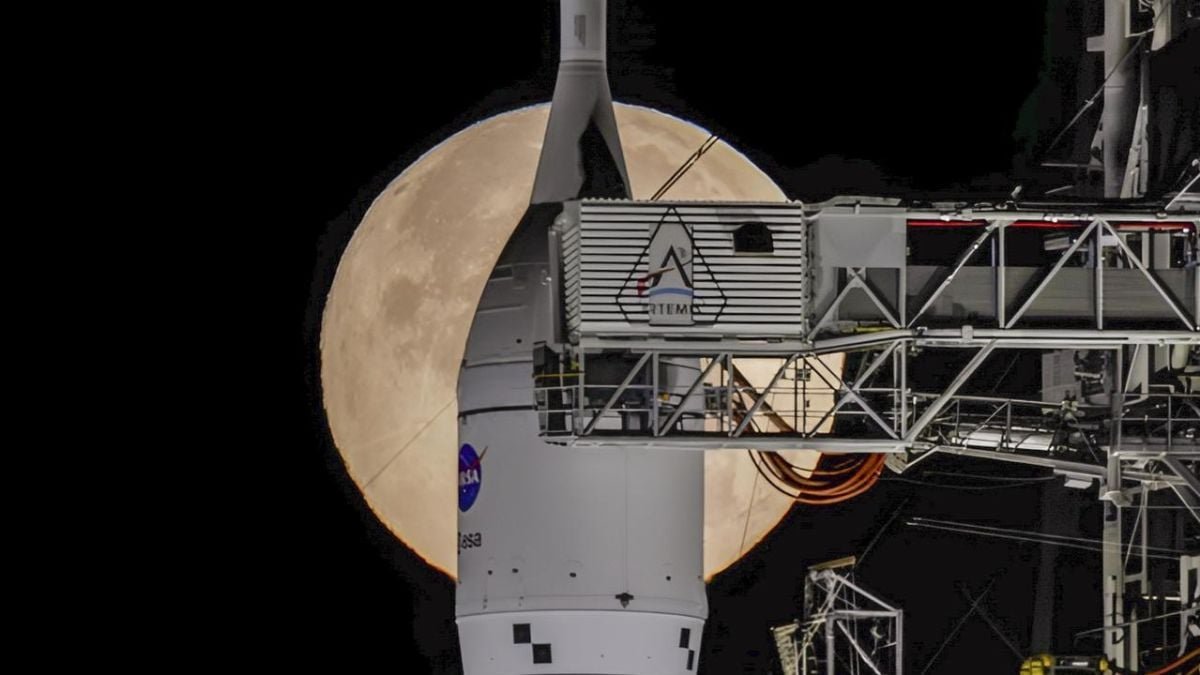
In the latest Artemis II launch update, NASA’s crewed return toward the Moon appeared to be in a much healthier place after weeks of delays tied to fuel leaks and other technical issues. That sounds like a story about schedules, weather and rocket operations. It is. But it is also a materials story, because every cryogenic line, seal, cable jacket, insulation layer, adhesive joint and heat-shield component on a mission like this depends on polymers doing their jobs under punishing conditions.
Officials reported a trouble-free countdown on the eve of launch, with favorable weather odds and a rocket that was behaving well on the pad. For most readers, that is the headline. For materials scientists and engineers, the deeper point is this: when a giant Moon rocket is loaded with super-cold propellants and prepared for a crewed flight, the success or failure of the operation often comes down to how well advanced materials handle stress, temperature swings, pressure changes and tiny mechanical imperfections.
That is one reason Artemis II matters well beyond spaceflight fandom. The mission will send four astronauts around the Moon and back, making them the first humans to travel that far from Earth since Apollo 17 in 1972. They will not land or enter lunar orbit, but the flight is still a major systems test for NASA’s Moon architecture. And hidden inside that architecture are some of the most demanding real-world applications of polymer science anywhere.
The source report described a launch campaign that had already been pushed back by hydrogen fuel leaks and then by clogged helium lines. Those may sound like plumbing problems. In aerospace, they are also materials problems. Hydrogen is notoriously difficult to contain. It is the smallest molecule, it can slip through tiny gaps and cryogenic temperatures can change how seals, gaskets, hoses, valves and coatings behave. A system that looks fine at room temperature can respond very differently once it is chilled by liquid hydrogen.
Why leaks become a materials challenge so quickly
Rockets using cryogenic propellants put enormous demands on elastomers and other polymer-based sealing materials. These components may need to stay flexible at very low temperatures, resist embrittlement, maintain contact pressure and survive repeated thermal cycling. If the material shrinks too much, stiffens too much, or takes a permanent set, even a microscopic gap can become important.
That is why the phrase fuel leak almost never means just one simple thing. Engineers need to think about surface finish, bolt load, geometry, vibration, contamination and manufacturing tolerances. But they also need to think about polymer chemistry: crosslink density, glass-transition behavior, thermal expansion mismatch, permeability, aging and compatibility with hydrogen-rich environments. On a crewed mission, the acceptable margin for error is even smaller.
NASA did not frame the launch update as a polymer-science bulletin, of course. Still, the subtext is unmistakable. When officials say a countdown is proceeding cleanly after earlier leak concerns, they are also saying that a chain of materials, interfaces, inspections and design decisions is now performing as intended.
The same goes for helium lines. Helium is used in pressurization and purge systems because it is inert and predictable, but it is also a small atom that can expose flaws in fittings and interfaces. In many aerospace systems, hard metals provide structure while polymeric elements provide sealing, cushioning, electrical isolation, or environmental protection. Reliability depends on that partnership.
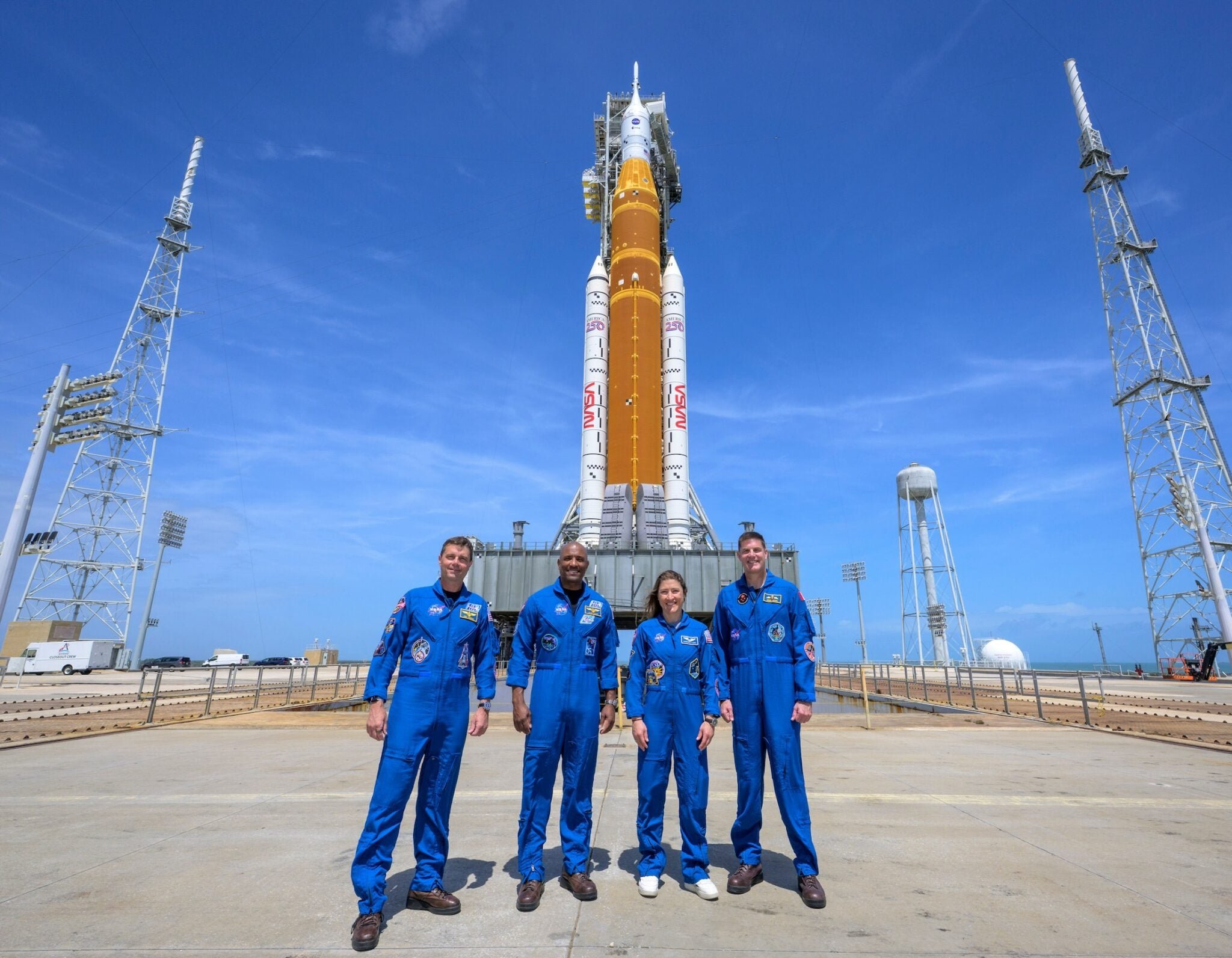
The crew assigned to Artemis II, photographed ahead of launch preparations, will become the first lunar visitors in more than half a century if the mission flies as planned. That human context changes how engineers think about materials performance. An uncrewed test can tolerate some risk in ways a crewed mission cannot. Human-rated systems demand higher confidence, tighter inspection and much more conservative interpretation of anomalies.
The polymers you do not see on the launch pad
To the eye, a Moon rocket looks like metal, ceramic tile, wiring and engines. In reality, polymers are everywhere. Some are obvious, like foam insulation and cable coatings. Others are less visible but just as important: structural adhesives, conformal coatings on electronics, resin systems in composite parts, protective paints, potting compounds, thermal blankets, lubricants, elastomeric seals and ablative materials designed to char in a controlled way.
On the launch side, insulation is one of the best-known examples. Cryogenic tanks and feed systems must limit heat flow into propellants, manage ice formation and maintain stable operating conditions. Polymeric foams and multilayer insulation systems can play major roles here. These materials must be light, durable and predictable under humidity, vibration and launch loads.
Wiring is another often-overlooked polymer success story. Spacecraft and launch vehicles rely on long runs of cable and the insulation around those conductors has to survive temperature extremes, radiation exposure, vibration and chemical attack. High-performance fluoropolymers and polyimide-based materials are frequently chosen because they combine electrical performance with heat resistance and low mass. Without them, modern spacecraft integration would be much harder.
Then there are adhesives and composite matrices. Even where metals still dominate primary structure, polymer-based systems often join, reinforce, protect, or isolate critical parts. Carbon-fiber composites, glass-fiber laminates and bonded sandwich structures can reduce weight while keeping stiffness high. In spaceflight, every kilogram saved matters. Lower mass can improve payload flexibility, margins and overall system efficiency.
Orion’s trip home may be the biggest polymer test of all
If launch is a trial for seals and insulation, reentry is a trial by fire for thermal protection. Artemis II’s Orion spacecraft will return to Earth at lunar-reentry speeds, meaning it will slam into the atmosphere far faster than a vehicle coming back from low Earth orbit. That produces extreme heating and the spacecraft survives it with a heat shield that depends on carefully engineered ablative materials.
Ablation is one of the most elegant ideas in aerospace materials science. Instead of trying to keep a surface perfectly unchanged, engineers allow part of the material to decompose, char, melt and carry heat away in a controlled manner. Polymer-rich ablatives are especially useful because their chemistry can be tuned to manage this sacrificial process. The material may break down, but it does so in a way that protects the structure underneath.
For Orion, NASA has used Avcoat, a heritage ablative system with roots in the Apollo era but updated for modern manufacturing and qualification needs. The exact engineering details matter enormously, but the broader lesson is simple: polymers are not merely convenient in space systems. Sometimes they are the reason a spacecraft can survive conditions that would otherwise destroy it.
That same logic applies to internal cabin materials, insulation behind the heat shield, acoustic dampers and components that must continue working after long exposure to launch vibration and vacuum. A spacecraft returning from the Moon is not just a shell. It is a layered materials system and polymers occupy many of those layers.
Why Artemis II is relevant to materials researchers on Earth
It is easy to treat space materials as exotic and disconnected from everyday industry. In practice, the link is much closer. Research on cryogenic sealing, lightweight composites, fire-resistant polymers, outgassing control, low-permeability barriers and durable coatings often feeds into terrestrial sectors such as hydrogen infrastructure, aviation, electric power, advanced manufacturing and industrial safety.
Hydrogen handling is a particularly important crossover. As more countries and companies invest in hydrogen as an energy carrier, the same basic materials questions show up again and again: which elastomers resist leakage best, how do polymers age during thermal cycling, which liners and barrier layers suppress permeation and how can joints be designed for reliability under fluctuating loads? Artemis II is a reminder that these are not abstract lab questions. They are operational questions with immediate consequences.
Likewise, extreme-temperature polymers developed for aerospace can influence batteries, electronics packaging, transportation and energy systems. Polyimides, fluoropolymers, silicone-based materials, toughened epoxies and high-temperature resin systems all have dual lives in research and industry. What starts as a specialized solution for a spacecraft may later prove useful in factories, vehicles, or harsh industrial environments.
The same is true for nondestructive inspection and quality assurance. Aerospace programs have pushed hard on methods to find hidden defects in bonded structures, composite laminates, thermal protection materials and seal interfaces. Those advances matter to wind energy, pressure vessels, rail transport and industrial pipelines as much as they matter to rockets.
Not glamorous, but mission critical
The public face of Artemis II is understandably human. Four astronauts. A return to deep space. A mission profile that reconnects the present with the last great era of lunar exploration. But missions like this are only possible because engineers spend years worrying about things the public rarely sees: tiny cracks, trapped bubbles, incompatible coatings, cure schedules, moisture uptake, seal compression and what happens to a polymer after sitting on a launch pad in a humid coastal climate.
That coastal setting matters. Kennedy Space Center is a demanding environment. Salt, moisture, ultraviolet exposure and temperature changes all place stress on exposed materials. Protective coatings, sealants, cable jackets and exterior polymer systems must tolerate long prelaunch periods without degrading in ways that could compromise performance. For a complex launch campaign, environmental durability is not a secondary issue. It is part of readiness.
This is one reason launch slips are not always signs of failure. Sometimes they are evidence that a system is being evaluated properly. When teams pause, inspect, drain, test and verify, they are taking seriously the fact that modern launch hardware is an intricate assembly of materials with different behaviors. Metal expands one way, a polymer another. A bondline reacts differently from a bolted joint. A cryogenic chilldown can expose weaknesses that no dry rehearsal will reveal.
The update describing favorable weather and a smooth countdown therefore carries an understated but important scientific message. It suggests that, for this window at least, the launch system and its materials have aligned closely enough to support a crewed attempt.
What a successful mission would signal
If Artemis II launches and completes its lunar flyby successfully, NASA will gain far more than a symbolic win. It will gather data on vehicle performance in deep space, crew operations, navigation, communications and high-speed reentry. It will also strengthen confidence in the material systems embedded throughout the rocket and spacecraft.
That confidence will matter for later Artemis missions, including those aimed at sending astronauts back to the lunar surface. Every successful seal, every stable insulation layer, every composite part that behaves as expected and every thermal protection element that survives its environment becomes part of the evidence base for more ambitious flights.
For polymer scientists, the mission is a useful reminder of what advanced materials really do in the world. They are not just samples in a characterization lab or data points in a paper. In the most demanding applications, they make systems lighter, safer, tougher and more resilient. They help contain cryogenic propellants, shield electronics, protect crews and absorb punishing heat on the journey home.
So while headlines focus on the countdown clock, the weather forecast and the astronauts heading to the pad, there is another drama playing out at the molecular scale. Can carefully designed polymer systems keep their shape, their adhesion, their flexibility and their protective function as the vehicle moves from humid Florida air to cryogenic fueling, from launch vibration to deep-space cold and from lunar return to atmospheric fire?
That quiet question sits behind every major space mission. Artemis II just happens to be asking it on one of the biggest stages possible.