

The European Space Agency’s Euclid mission has delivered its first look at the telescope’s three deep fields, offering an early but powerful preview of a survey designed to answer some of the biggest questions in modern cosmology. The release is not simply a gallery of striking images. It is the opening phase of a long, data-rich experiment to map how matter is distributed across the Universe and how cosmic expansion has changed over billions of years.
Euclid launched in July 2023 with a clear scientific goal: to investigate the invisible framework of the cosmos. Astronomers often call this the dark Universe, a phrase that refers to dark matter and dark energy, which together appear to dominate the contents and behavior of the cosmos while remaining poorly understood. Dark matter cannot be seen directly, but its gravity shapes galaxies and clusters. Dark energy is the name given to the phenomenon driving the accelerating expansion of the Universe.
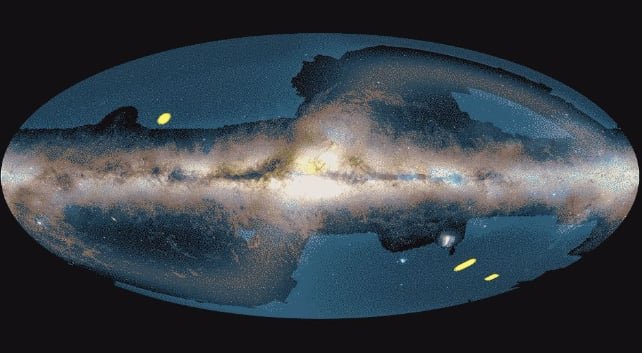
To study those hidden ingredients, Euclid is undertaking a massive sky survey. Over the course of the mission, it is expected to image billions of galaxies stretching back as far as 10 billion light-years and beyond, covering more than one-third of the sky. The first deep-field release shows the mission beginning that task in earnest.
The newly released data come from the first scans of three carefully selected deep-field regions. These patches of sky will be observed repeatedly throughout Euclid’s mission, allowing scientists to build extremely deep, highly detailed views of distant galaxies and the large-scale cosmic web that connects them. Even from just one early pass through each region, Euclid has already revealed an enormous population of galaxies, gravitational lenses, galaxy clusters and a wide range of galactic shapes and structures.
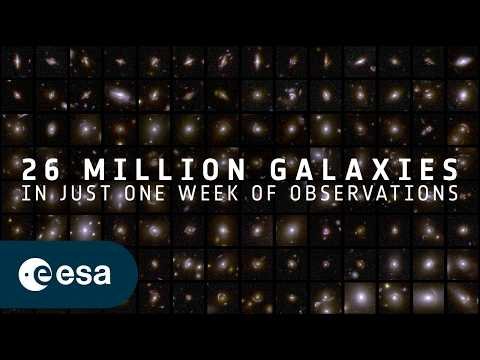
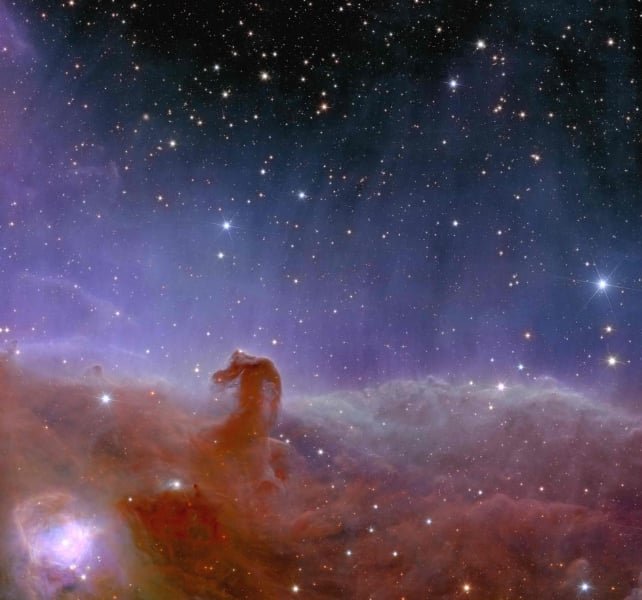
ESA says Euclid used roughly one week of observing time to scan each deep field once. That limited first effort was enough to detect about 26 million galaxies, with the most distant seen in this release lying around 10.5 billion light-years away. That number alone gives a sense of the scale involved. Yet it represents only the very beginning of the mission: ESA notes that these galaxies amount to just about 0.4% of the total number of similarly resolved galaxies Euclid is expected to record over its lifetime.
Why deep fields matter
Deep-field astronomy has a long record of changing how people think about the cosmos. The Hubble Space Telescope’s deep fields famously showed that apparently empty regions of space are crowded with galaxies when observed with sufficient sensitivity and time. Euclid is now extending that idea with a different emphasis. Instead of only pushing toward visually dramatic depth, it is combining depth, area and statistical power on a scale suited to precision cosmology.
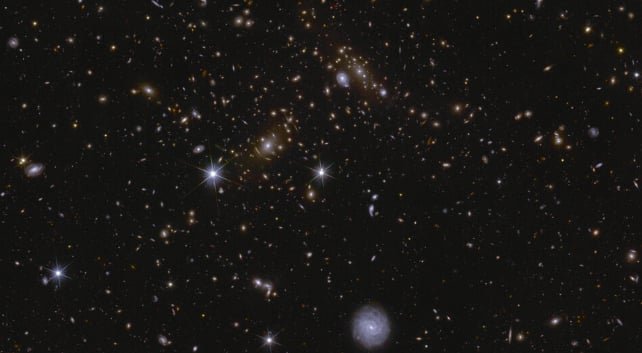
The mission’s deep fields are essential because they will be revisited many times, building a layered dataset that improves both image quality and scientific confidence. Repeated observations help astronomers detect faint objects, refine galaxy shapes, measure distances more accurately and identify subtle effects caused by gravity bending light. Those effects are central to Euclid’s purpose.
Dark matter leaves no direct glow for a telescope to photograph. Instead, astronomers infer its presence through its gravitational influence. One of the most useful clues is gravitational lensing, in which massive objects such as galaxies or galaxy clusters distort the light from more distant background galaxies. By measuring those distortions across enormous numbers of galaxies, researchers can map where matter, including dark matter, is concentrated.
That is why Euclid’s deep fields are so valuable. They are not merely pretty sky images. They are precisely calibrated maps from which the geometry of the Universe can be extracted. Tiny shape changes in distant galaxies, when measured across millions or eventually billions of objects, can reveal how matter is distributed and how cosmic structure has grown over time.
A telescope built for survey science
Euclid is not designed like a traditional observatory that spends much of its time examining one target after another in detail. It is built as a survey machine. Its strength lies in combining large sky coverage with high image quality and careful measurement of both visible and near-infrared light.
The spacecraft carries two main scientific instruments. The first is VIS, a visible-light imaging camera that captures the sharp galaxy shapes needed for weak gravitational lensing studies. The second is NISP, the near-infrared spectrometer and photometer, which helps determine galaxy distances and properties. Together, these instruments allow astronomers to connect where galaxies appear on the sky with how far away they are and how massive the structures around them may be.
This combination is crucial. A two-dimensional picture of the sky is useful, but Euclid’s science depends on turning that picture into a three-dimensional map. Distances let researchers reconstruct the cosmic web, the vast network of filaments and nodes made of ordinary matter and dark matter, along which galaxies and galaxy clusters assemble. Once that web is mapped across cosmic time, scientists can compare the observed pattern with theoretical models of how the Universe evolved.
The mission also benefits from an unusually large data stream. Euclid’s imaging system is designed to collect enormous, high-resolution datasets that can be stitched together into panoramic maps of the sky. That makes the mission as much a triumph of data processing and survey engineering as of optics and spacecraft design.
What the first release shows
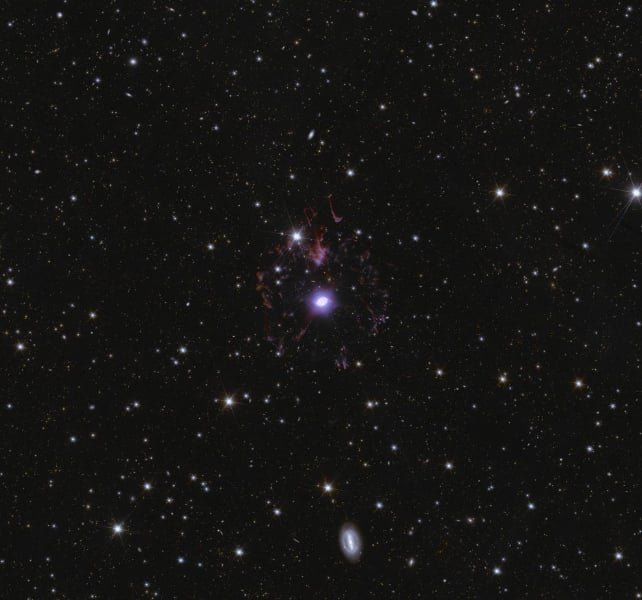
The first deep-field data release already contains several layers of scientific value. At the most basic level, it confirms that Euclid is performing as intended. The images show crowded fields teeming with galaxies, from nearby systems with clear internal structure to much more distant smudges whose light has traveled for billions of years. In some views, foreground objects within our own galaxy appear alongside a background so dense with external galaxies that the scale of the survey becomes immediately apparent.
More importantly, the release demonstrates Euclid’s ability to uncover rare but highly informative phenomena. ESA also published a catalogue of 500 strong gravitational lenses, almost all of them previously unknown. Strong lenses occur when a massive foreground object produces dramatic arcs, rings, or multiple images of a background galaxy. These systems are valuable because they allow especially direct measurements of mass distribution and can probe both galaxy evolution and cosmology.
The process used to find these lenses is also notable. According to ESA, the candidates were identified through a combination of artificial intelligence, follow-up examination by citizen scientists and final expert vetting and modelling. That workflow reflects a growing reality in astronomy: modern surveys are producing more data than experts alone can classify quickly. Automated tools are now essential, but they are often strongest when combined with human pattern recognition and scientific oversight.
The mission’s early scans have also identified galaxy clusters and a wide variety of galaxy morphologies. That matters because Euclid is not only a dark-matter mission. Its archive will become a major resource for studying how galaxies form and change. Researchers will be able to look at galaxies “from inside to out,” linking internal structure with the surrounding environment. Over time, the mission should provide a morphology catalogue at least an order of magnitude larger than any previous dataset of comparable quality.
A first step toward understanding dark matter and dark energy
Euclid’s long-term importance lies in its ability to connect galaxy shapes, galaxy positions and galaxy distances over enormous volumes of space. That is the observational basis for testing ideas about dark matter and dark energy.
Dark matter appears to provide much of the gravitational scaffolding that allowed galaxies and clusters to form. Without it, the structure seen in the Universe today is difficult to explain. Dark energy, meanwhile, enters the picture through cosmic expansion. Observations over the past few decades have shown that the expansion of the Universe is accelerating, not slowing down. The cause remains one of the deepest puzzles in physics.
Euclid will not “see” dark energy directly and it will not isolate dark matter in a laboratory sense. Instead, it will constrain theories by measuring the history of structure formation and expansion with high precision. If dark energy has behaved consistently over time, or if gravity operates differently on large scales than current models assume, the pattern should be imprinted in the survey data.
That is why the current release should be viewed as foundational rather than final. ESA and members of the Euclid Consortium have emphasized that the full scientific power of the mission will only emerge once the entire survey is complete. Even so, the first release already offers a meaningful look at the large-scale organization of galaxies and the kinds of measurements Euclid will make increasingly well as its data accumulate.
How Euclid compares with earlier mapping missions
There are useful parallels between Euclid and ESA’s Gaia mission, though the targets are very different. Gaia has transformed astronomy by making an ultra-precise map of more than two billion stars and other objects in the Milky Way. That dataset has become a core reference for studies of stellar motion, galactic history and even small Solar System bodies.
Euclid is positioned to play a similar role beyond the Milky Way. Instead of providing a foundational map of our home galaxy, it aims to create a foundational map of the large-scale extragalactic Universe. Once such a dataset exists, scientists will use it for far more than the mission’s headline goals. The archive should support work on galaxy evolution, cluster physics, gravitational lensing, rare-object discovery and the statistical properties of cosmic structure across time.
That broader impact may prove just as important as the mission’s direct cosmology results. Large public surveys often change science not only by answering planned questions, but by making new questions possible. Hubble’s deep fields, Sloan Digital Sky Survey maps and Gaia catalogues all became enabling infrastructure. Euclid appears likely to join that group.
The role of data science in modern astronomy
The scale of the Euclid mission also highlights a wider shift in scientific practice. Modern astronomy increasingly depends on the integration of precision instruments, advanced pipelines, machine learning, cloud-scale storage and large collaborative networks. Euclid’s first deep-field release is a reminder that observing the Universe now involves not just taking images, but building systems capable of extracting reliable meaning from immense data volumes.
The gravitational lens catalogue is a clear example. A survey covering such large areas at high resolution will produce more candidate features than experts can inspect one by one in a traditional way. AI systems can rapidly flag promising cases, but those systems still need careful validation. Citizen science adds another layer, enabling many eyes to search for unusual features, while professional astronomers provide modelling and confirmation. In practice, discovery becomes a pipeline.
This approach is especially important for Euclid because subtle measurement errors could affect conclusions about dark matter and dark energy. Mapping faint distortions in galaxy shapes demands rigorous calibration and statistical care. The mission’s success therefore depends as much on data quality and analysis frameworks as on the telescope hardware itself.
What comes next
Euclid’s mission is scheduled to run through 2030 and the deep fields will be scanned dozens of times over that period. Each new pass will deepen the images and improve the resulting measurements. Features that are only suggestive in the current release may become robust scientific tools in later datasets. The same is true for rare phenomena such as strong lenses, unusual galaxy mergers and distant clusters that become easier to characterize as observations accumulate.
Future data releases should also sharpen the statistical power of the mission. A single image can inspire, but cosmology depends on patterns across very large samples. Euclid is being built up, release by release, into a machine for measuring those patterns. The early result is a glimpse; the completed survey should be a map.
For now, the first deep-field images demonstrate that the telescope is delivering the kind of rich, high-density extragalactic view astronomers hoped for. They show a sky filled with galaxies at every scale and distance. They confirm Euclid’s ability to uncover new gravitational lenses. And they mark the beginning of a long campaign to chart the structure of the Universe with unprecedented breadth and depth.
ESA’s message is straightforward: this is only the start. The 26 million galaxies in the current release are impressive on their own, but they are a tiny fraction of what Euclid is expected to capture before the mission ends. As the survey grows, so too will its value for testing cosmological models and for understanding how galaxies evolved within the cosmic web.
In that sense, Euclid’s first deep fields are both a scientific result and a promise. They do not yet solve the mystery of the dark Universe. But they show that the observational machinery needed to make real progress is now in place.
Key figures from the first Euclid deep-field release
- Mission operator: European Space Agency, with the Euclid Consortium and international partners.
- Launch: July 2023.
- Main goal: Investigate dark matter, dark energy and the growth of cosmic structure.
- Survey scope: More than one-third of the sky over the mission lifetime.
- First deep-field sample: Three deep fields scanned once in an initial release.
- Galaxies already identified: About 26 million.
- Most distant galaxies in this release: Roughly 10.5 billion light-years away.
- Strong gravitational lenses catalogued: 500, with most previously unknown.
- Mission duration: Planned through 2030.
- Fraction of expected lifetime galaxy total represented so far: Around 0.4%.
More information on the mission and its data releases is available from the European Space Agency. Background on deep-field astronomy can be found via NASA’s Hubble resources and an overview of the cosmic web is available from NASA.
Related reading
More journal reading and science coverage connected to this topic.
Polymerization Technology
A modern overview of how reaction engineering shapes polymer architecture, productivity, and scale-up.

Research on pretreatment technology for corn husk degumming
Title: Research on pretreatment technology for corn husk degumming Page Range: p.687-692 Author(s): Rong Zhou; Mingxia Yang; Haixia Zhang File size: Download the pdf…
STUDY OF DIFFUSION PERFORMANCE AND PREPARATION TECHNOLOGY OF THE COLOURED PMIA FIBRE
Title: STUDY OF DIFFUSION PERFORMANCE AND PREPARATION TECHNOLOGY OF THE COLOURED PMIA FIBRE Page Range: p.601-608 Author(s): Li-Qi Liu; Lei Chen; Zu-Ming Hu; Jun-Rong…