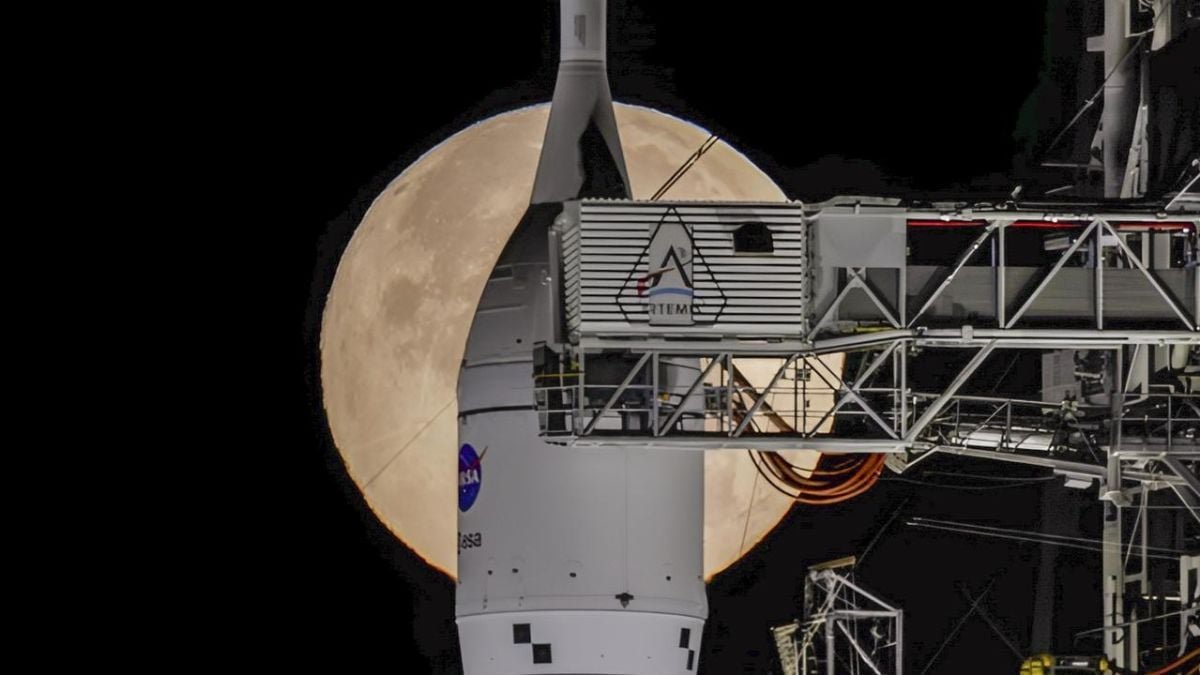
After a frustrating run of delays, leaks and technical snags, NASA says conditions are finally looking more favorable for Artemis II, the mission set to send astronauts toward the Moon for the first time since the Apollo era. In the latest prelaunch reporting, covered by the Associated Press, officials said the countdown had been trouble-free and weather forecasters were giving the launch a strong chance of acceptable conditions. For a mission carrying four astronauts on one of the most closely watched flights in modern spaceflight, that is a meaningful shift.
NASA does not get many easy Moon launches. Artemis II depends on a narrow combination of hardware readiness, weather, fuel-handling stability and timing in space. That means even small problems on the ground can force a delay of days or weeks. So when officials at Kennedy Space Center describe the rocket as performing well on the pad and the forecast as promising, it is more than a routine update. It is a sign that the agency may finally be lining up the many moving parts needed to push a crewed lunar mission off Earth.
Senior test director Jeff Spaulding summed up the mood simply: everybody understands the significance of this launch. That is not hard to see. Artemis II is not just another crewed mission. It is meant to be the first time humans have traveled back into deep space, beyond low Earth orbit, since Apollo 17 in 1972.
The mission is short on landing drama, but huge in historical weight
Artemis II will not land on the Moon. It will not even slip into lunar orbit. Instead, the spacecraft will carry its crew around the Moon on a free-return trajectory and then head back to Earth. That might sound modest compared with the Moon landings of the late 1960s and early 1970s, but it is exactly the kind of flight NASA needs before attempting a lunar landing mission later in the Artemis program.
The crew will test the Orion spacecraft in the harsh environment beyond Earth orbit, where communications, navigation, life-support systems, radiation exposure and crew operations become far more demanding. Every stage of the mission matters: launch, separation, outbound cruise, the lunar flyby, return transit, re-entry and splashdown. Artemis II is therefore both a symbolic return and a practical shakedown of the systems NASA wants to trust for future missions.
That is why the latest launch outlook matters so much. A crewed Moon mission can tolerate neither uncertainty nor improvisation. NASA must be satisfied not only that the rocket can leave the pad, but that the vehicle stack, the fueling systems, the ground hardware and the forecast all sit within strict safety limits.
Why recent delays have been so important
The path to this launch attempt has not been smooth. NASA had already been forced to slip the mission after hydrogen fuel leaks caused concern. Then another problem, involving clogged helium lines, pushed the schedule back again. Neither issue sounds glamorous, but both strike at the center of launch reliability.
Hydrogen is an especially difficult propellant to work with. It is extremely cold in liquid form, its molecules are tiny and it can escape through places that would hold other gases more easily. That makes seals, valves, joints and feed systems crucial. When hydrogen leaks appear during launch processing, engineers do not treat them casually. They stop, inspect, retest and only move forward when they are confident the system is behaving within expected limits.
Helium, meanwhile, plays a quieter but still essential role in many launch systems. It is often used to pressurize tanks and help manage fluid movement. A clogged helium line can affect operations in ways that are hard to wave away, because launch systems are tightly choreographed. If the flow of a pressurizing gas is not right, the effects can ripple into fueling sequences and vehicle performance margins.
That helps explain why Artemis II has reached this moment only after repeated caution. NASA knows the mission carries not just a crew, but the political and technical future of the Artemis program. A rushed launch would be a self-inflicted mistake.
The crew carrying the weight of a new lunar era
The four astronauts assigned to Artemis II are three Americans and one Canadian: Reid Wiseman, Victor Glover, Christina Koch and Canadian Space Agency astronaut Jeremy Hansen. Together they represent more than a single crew manifest. They are the first people selected to travel toward the Moon in more than half a century.
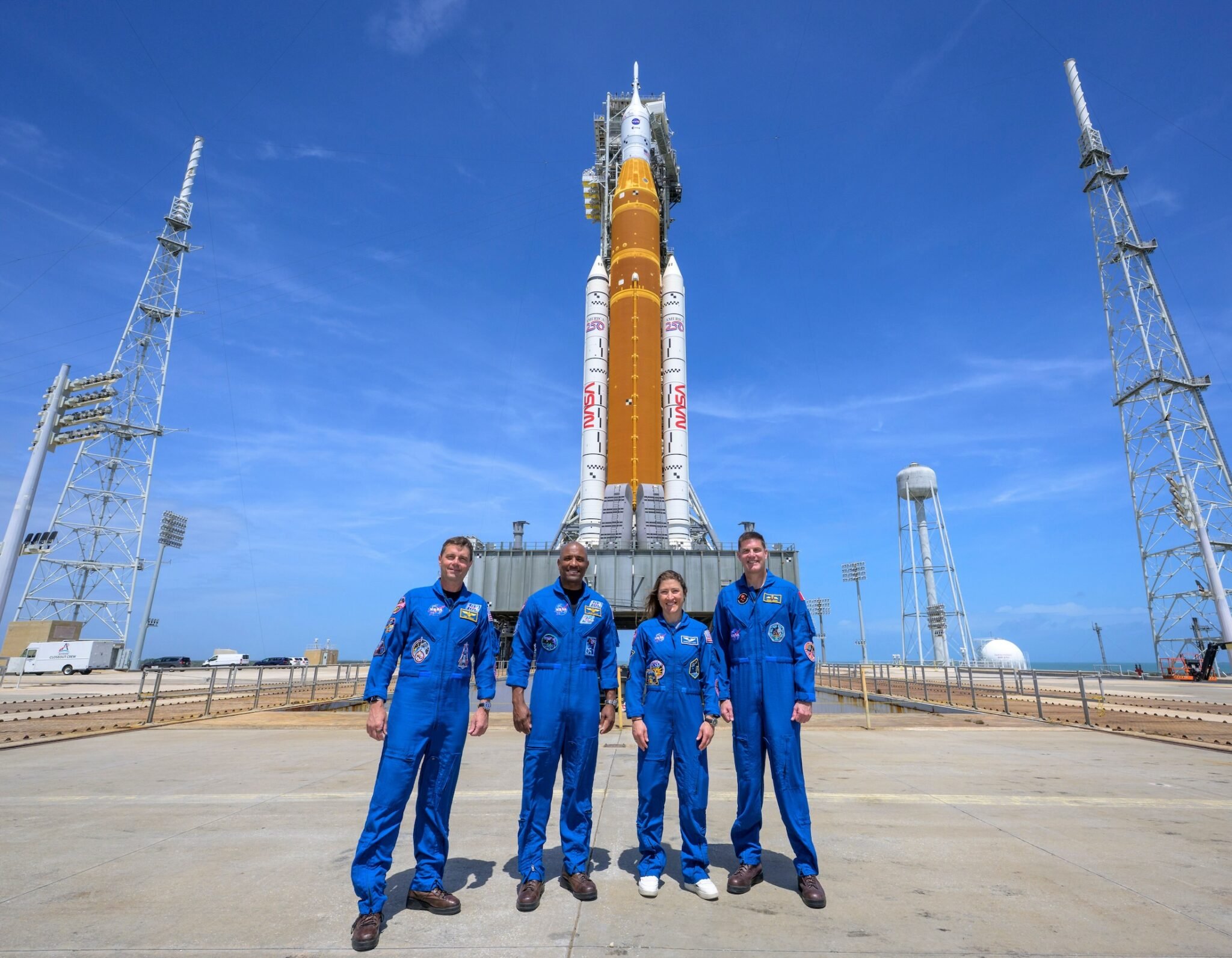
The international aspect is also important. Artemis has been framed not only as a US program, but as a broader coalition effort involving multiple agencies and partner nations. Hansen’s presence on the crew reflects that strategy. So does the wider Artemis architecture, which is designed to support future cooperation in cislunar space and on the lunar surface.
For the astronauts themselves, the mission will be unusual. They will be close enough to the Moon to experience the reality of deep-space flight, but without the landing operations that people often associate with lunar exploration. That changes the public picture of the mission, but not its difficulty. A crewed lunar flyby still demands confidence in navigation, power, propulsion, communications and crew safety over a long-distance mission profile that no human space program has attempted in generations.
Why weather and launch windows matter so much
NASA reportedly had only a small number of days each month when it could send Artemis II on its planned path to the Moon. That is one of the less visible reasons launch delays become so painful. The Moon does not wait for a convenient calendar slot and the mission’s trajectory has to align with orbital mechanics, lighting, recovery conditions and spacecraft performance constraints.
Then there is the weather. A forecast showing 80% odds of favorable conditions is good news, but it is not a guarantee. Launch weather rules are strict because rockets are vulnerable to wind, lightning, clouds with certain electrical properties, precipitation and field conditions downrange. When the mission involves a crew and a giant lunar rocket, the standards only become tighter.
Weather on launch day also connects to safety after liftoff. NASA and its partners consider not just the moment of ignition, but the broader environment the vehicle may encounter as it climbs. Thunderstorms, anvil clouds, upper-level winds and triggered lightning risks can all become reasons to scrub.
That is why officials sound cautious even when they sound optimistic. A calm countdown and a positive forecast are necessary ingredients, but not the whole recipe.
The rocket at the center of it all
Artemis II will fly atop NASA’s Space Launch System, or SLS, the agency’s heavy-lift rocket developed for deep-space missions. Sitting above it is Orion, the spacecraft designed to carry astronauts beyond low Earth orbit. Together they form the backbone of NASA’s current human lunar strategy.
SLS is powerful, but like most giant rockets it is also unforgiving. Large cryogenic stages, complex fueling systems and ground umbilicals mean there are many places where temperatures, pressures and timing must stay inside narrow bands. The hydrogen leak issues that delayed Artemis II are a reminder that in rocketry, success often depends less on headline-making hardware than on whether valves, seals, lines and interfaces behave exactly as intended during the final hours before launch.
That is one reason launch campaigns are often described as tests as much as operations. Every countdown is a real-time examination of the full system. The rocket can look perfect in planning documents and still present surprises when tanks are loaded, temperatures plunge and gases start moving through the plumbing at operational rates.
For NASA, a smooth countdown after earlier trouble is therefore a strong signal. It suggests the corrective actions taken after the previous issues may be holding up under realistic conditions. It does not erase all risk, but it does improve confidence.
What Artemis II is meant to prove
NASA’s earlier Artemis I mission sent an uncrewed Orion around the Moon and back. Artemis II raises the stakes by putting people on board. That changes everything. Human-rating a mission means the spacecraft must sustain a habitable environment, support the crew through contingencies and deliver them safely home after a high-speed return through Earth’s atmosphere.
In that sense, Artemis II is a bridge mission. It sits between a largely automated test flight and the more ambitious crewed lunar missions NASA wants to carry out next. If it goes well, the flight will strengthen the case that Orion, SLS and the broader Artemis framework are ready for the next step. If it runs into major trouble, the consequences could reach far beyond a single mission timeline.
The mission is also intended to restore operational knowledge that has been absent since the Apollo years. Space agencies have gained enormous expertise in low Earth orbit through the space shuttle era and the International Space Station, but lunar flight is a different category. Communications delays are longer. Abort options are different. Thermal and power planning change. So do crew psychology and mission operations when Earth is no longer close by.
Artemis II, in other words, is not just about going back. It is about relearning how to work in a part of space humans once visited, then left behind.
A launch that carries technical, political and public pressure
There is another layer to all of this. Artemis is not flying in a vacuum, politically or culturally. It is being watched as a test of whether major government-led exploration programs can still deliver on long timelines and large budgets. Every delay invites criticism. Every successful milestone buys breathing room.
That makes this prelaunch improvement especially important for NASA. A trouble-free countdown signals competence. It reassures the public that the earlier setbacks were not signs of a program spinning out of control, but examples of exactly what launch teams are supposed to do: find problems before liftoff, fix them and verify the fixes under real operational conditions.
The public symbolism matters too. Artemis II offers the kind of image NASA has been building toward for years: a crew standing at the threshold of a Moon mission, representing a new generation rather than a replay of the old one. Christina Koch and Victor Glover in particular have drawn attention as part of a crew lineup that reflects a broader picture of who gets to be seen at the front edge of exploration.
But symbolism only works if the rocket flies. That is why the emphasis remains on countdown discipline, engineering performance and launch-day weather.
What happens next if Artemis II gets off the ground
If the vehicle launches on schedule, the mission will begin with the most violent phase of the journey: ascent aboard SLS. After reaching space, Orion will separate and begin the complex sequence that takes the crew away from Earth and onto the planned lunar path. Along the way, astronauts and flight controllers will test spacecraft systems and crew operations that future Artemis missions may depend on.
The lunar flyby itself will be the emotional center of the mission. Even without a landing, it will mark the first time since 1972 that humans have traveled into the Moon’s neighborhood. The crew will then return to Earth, where Orion will make a fast re-entry and splash down for recovery.
A successful mission would give NASA valuable data on spacecraft behavior, crew workloads, communications performance and systems integration. Just as important, it would provide confidence that the program can support the missions planned to follow.
For now, cautious optimism is enough
Spaceflight has a way of humbling certainty. A rocket that looks healthy one day can stand down the next. A good weather forecast can turn. A small sensor reading can send engineers back into review. That is why no serious launch team declares victory too early.
Still, the latest signs around Artemis II are plainly encouraging. The rocket appears to be behaving on the pad. The countdown is proceeding without the same visible drama that marked earlier attempts. The weather outlook is favorable. And the crew waiting to fly knows exactly what is at stake.
If Artemis II launches as planned, it will not just send four astronauts around the Moon. It will reopen a route that has been silent for more than 50 years and test whether NASA is finally ready to make deep-space human flight routine again. For a mission built on patience, setbacks and careful engineering, even a single smooth countdown is a milestone worth noticing.