
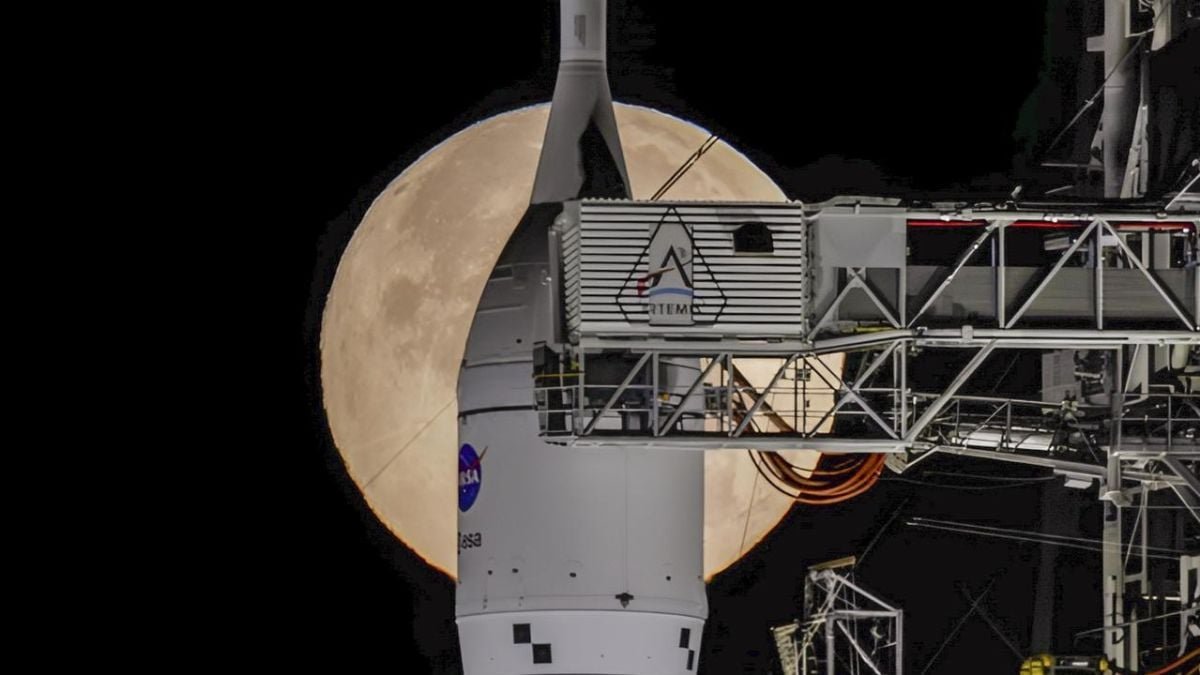
NASA is moving toward a major milestone in human spaceflight as conditions for the Artemis II launch look increasingly favorable. After weeks of technical setbacks involving fuel leaks and other launch-pad issues, the agency reported a clean countdown on the eve of what would be the first crewed trip to the Moon in more than half a century.
The mission is historic not only because it would send astronauts back toward the Moon, but because it will test the systems needed for future deep-space travel. Four astronauts, three from the United States and one from Canada, are scheduled to ride the Space Launch System rocket around the Moon and back without landing. If successful, Artemis II will be the farthest humans have traveled from Earth in a crewed spacecraft since Apollo 17 in 1972.
At NASA’s Kennedy Space Center in Florida, the launch team said the rocket was behaving well on the pad and that weather conditions were trending positive. Forecasters gave the launch window an 80% chance of favorable weather, an encouraging sign after a string of delays tied to the complex fueling and ground-support systems required for the mission.
“Everybody’s pretty excited and understands the significance of this launch,” said senior test director Jeff Spaulding, reflecting the mood at the center as teams prepared for the next phase of the countdown.
A mission designed to prove systems before the next step
Artemis II is not a landing mission. Instead, it is a demanding test flight that will send the crew on a loop around the Moon and return them safely to Earth. That profile makes the mission both safer and strategically important. NASA needs to prove the rocket, spacecraft, life-support systems, communications, navigation and recovery operations before sending astronauts to the lunar surface later in the Artemis program.
The spacecraft will be launched atop the Space Launch System, a 32-story rocket built to deliver heavy payloads and crew beyond low Earth orbit. For a mission like this, even seemingly small issues can have major consequences. Cryogenic fuels, ultra-cold helium plumbing and tightly timed countdown procedures all have to work together with high precision.
That is why the recent setbacks drew so much attention. Hydrogen fuel leaks forced one launch date change, while clogged helium lines pushed the schedule again. NASA only has a limited number of launch opportunities each month because of orbital mechanics, crew safety rules and the need to align the spacecraft’s trajectory with the Moon’s position.
Now, with those issues believed to be fixed, the launch team plans to begin fueling the rocket on Wednesday morning for an evening liftoff. For mission planners, a clean fueling operation would be a strong sign that the vehicle and ground systems are ready for flight.
The crew and the significance of the flight
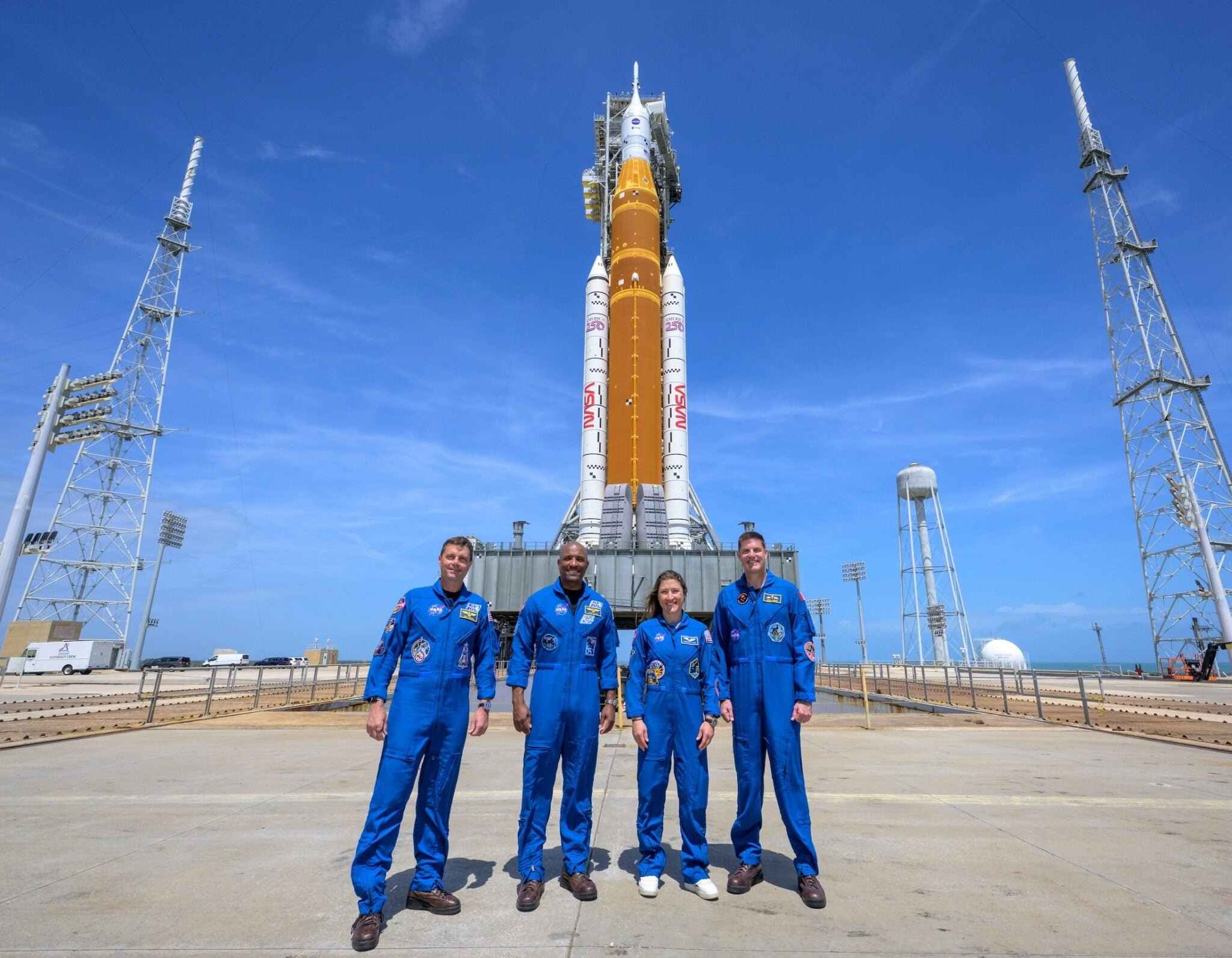
The Artemis II crew includes NASA astronauts Reid Wiseman, Victor Glover and Christina Koch, along with Canadian Space Agency astronaut Jeremy Hansen. Their assignment reflects both the international nature of the Artemis program and the broader goal of building a sustained human presence in deep space.
This flight will also be closely watched because of what it represents for human exploration. Artemis II is not just about returning to the Moon as a destination. It is about developing a new operational model for long-duration missions beyond Earth orbit, where spacecraft must carry their own life support, radiation protection, guidance capability and emergency margins.
Unlike the Apollo missions, which were designed for short visits and intense racing pressure, Artemis is intended to become a long-term architecture. The Moon is being treated as a proving ground for future missions to Mars and other deep-space destinations. In that sense, Artemis II is both a destination flight and a systems engineering test.
The astronauts will become the first lunar visitors since Apollo 17, but their journey will look different from the lunar landings of the past. They will not touch down on the surface or enter lunar orbit. Instead, they will use the Moon’s gravity to swing around it and come home, demonstrating that the spacecraft can support crewed travel in deep space for the duration of the mission.
Why the recent delays matter technically
The launch delays were not surprising to engineers familiar with cryogenic propulsion and integrated launch systems. Hydrogen is an exceptionally efficient rocket fuel, but it is also difficult to handle because it is extremely cold, leaks easily and requires very tight sealing and monitoring. Helium is used in support systems and tank pressurization and clogged lines can interrupt critical prelaunch operations.
In a mission like Artemis II, ground systems matter nearly as much as the spacecraft itself. The rocket depends on a chain of pumps, valves, seals, sensors and countdown logic that must all work together under demanding thermal and pressure conditions. If one part of the system behaves unexpectedly, launch managers often have no choice but to stand down and investigate.
That caution is not a weakness; it is how human spaceflight protects crews. Every delay gives engineers another chance to confirm that the vehicle is behaving as expected. For a mission carrying astronauts beyond Earth orbit, the margin for error must be extremely small.
The recent progress suggests that the launch team has isolated the problems and restored confidence in the hardware. A successful fueling test would be especially important because it exercises many of the systems that proved troublesome earlier in the campaign.
What the crew will experience in space
Artemis II will provide NASA with valuable crewed-flight data in a deep-space environment. The astronauts will experience a launch aboard one of the most powerful rockets ever built, then travel farther from Earth than any human crew has gone in generations. Along the way, they will evaluate the spacecraft’s behavior under conditions that cannot be replicated in low Earth orbit.
Among the most important areas of study are guidance, navigation, environmental control, communication latency and crew health in a radiation-rich environment. Deep space exposes astronauts to risks that are less severe in Earth orbit, including higher doses of cosmic radiation and longer communication delays. These factors make real flight testing essential.
The mission will also show how well the Orion spacecraft supports its crew during a long journey. Cabin systems must maintain temperature, pressure, air quality and water management while the spacecraft is far from rapid rescue options. Any issue that seems manageable near Earth becomes much more serious when the vehicle is headed around the Moon.
Why the launch window is so narrow
NASA’s launch opportunities are constrained by orbital mechanics and mission design. The Moon is always moving relative to Earth and the trajectory needed to send a crew around it and bring them home safely must be timed with precision. That is why the agency has only a handful of days each month in which a launch is practical.
These windows also reflect operational realities on the ground. Weather, lightning risk, wind and technical readiness all play a role. A launch team may be ready in principle, but if the atmosphere or the rocket systems are not within strict limits, the countdown must stop.
For Artemis II, the combination of improving weather and a trouble-free pad status gave the team a strong reason for optimism. In the world of launch operations, that combination is often the difference between another delay and a successful departure.
What comes next if launch proceeds
If the mission launches on schedule, the next major step will be ascent and verification of all major flight systems. Early in the mission, NASA will watch how the rocket and spacecraft perform under the stress of launch, stage separation and the transition into deep space. After that, the crew will begin the long outbound journey toward the Moon.
Because the mission is intended to validate systems rather than perform a landing, its success will be measured in careful engineering terms. Did the rocket provide the expected trajectory? Did the spacecraft maintain stable conditions for the crew? Did communications, power and thermal control function as designed? Did the astronauts and ground controllers complete key checks without surprises?
Those answers will help determine how quickly NASA can move toward the next phase of Artemis, which is designed to send astronauts to the lunar surface later in the program. In that broader plan, Artemis II is a critical bridge between uncrewed testing and sustained lunar exploration.
Why this matters beyond NASA
The mission is also important for the wider technology and industrial ecosystem that supports spaceflight. Artemis depends on large-scale manufacturing, precision systems integration, advanced materials, telemetry, robotics and safety engineering. A mission of this complexity requires coordination across many disciplines and many organizations.
That makes Artemis II a useful reminder that space exploration is not only a scientific endeavor but also a test of industrial capability. The rocket, capsule, launch infrastructure and recovery systems all depend on decades of engineering progress. Every countdown rehearsal and pad check captures lessons that can influence future spacecraft design, launch reliability and mission planning.
For the public, the appeal is straightforward: a crew is about to travel around the Moon for the first time in a generation. For engineers, the meaning is even deeper. This is a proof of architecture mission, one that could shape how humans move beyond Earth for years to come.
Key points from the Artemis II countdown
- NASA reported a trouble-free countdown after earlier delays tied to fuel leaks and helium line problems.
- Weather forecasts gave the launch an 80% chance of favorable conditions.
- The mission will send four astronauts around the Moon and back without landing.
- It will be the first crewed lunar mission since Apollo 17 in 1972.
- The Space Launch System rocket is scheduled to be fueled ahead of the planned evening liftoff.
- Artemis II is a major systems test for future crewed lunar landings and deep-space missions.
For NASA, the next few hours and days are about precision, patience and execution. For the astronauts, they are about preparing to undertake one of the most symbolic journeys in modern exploration. If the launch proceeds as planned, Artemis II will mark the beginning of a new chapter in human lunar travel.
And for spaceflight watchers around the world, the message is simple: the Moon is once again within reach.
Related reading
More journal reading and science coverage connected to this topic.
Polymerization Technology
A modern overview of how reaction engineering shapes polymer architecture, productivity, and scale-up.

Research on pretreatment technology for corn husk degumming
Title: Research on pretreatment technology for corn husk degumming Page Range: p.687-692 Author(s): Rong Zhou; Mingxia Yang; Haixia Zhang File size: Download the pdf…
STUDY OF DIFFUSION PERFORMANCE AND PREPARATION TECHNOLOGY OF THE COLOURED PMIA FIBRE
Title: STUDY OF DIFFUSION PERFORMANCE AND PREPARATION TECHNOLOGY OF THE COLOURED PMIA FIBRE Page Range: p.601-608 Author(s): Li-Qi Liu; Lei Chen; Zu-Ming Hu; Jun-Rong…