
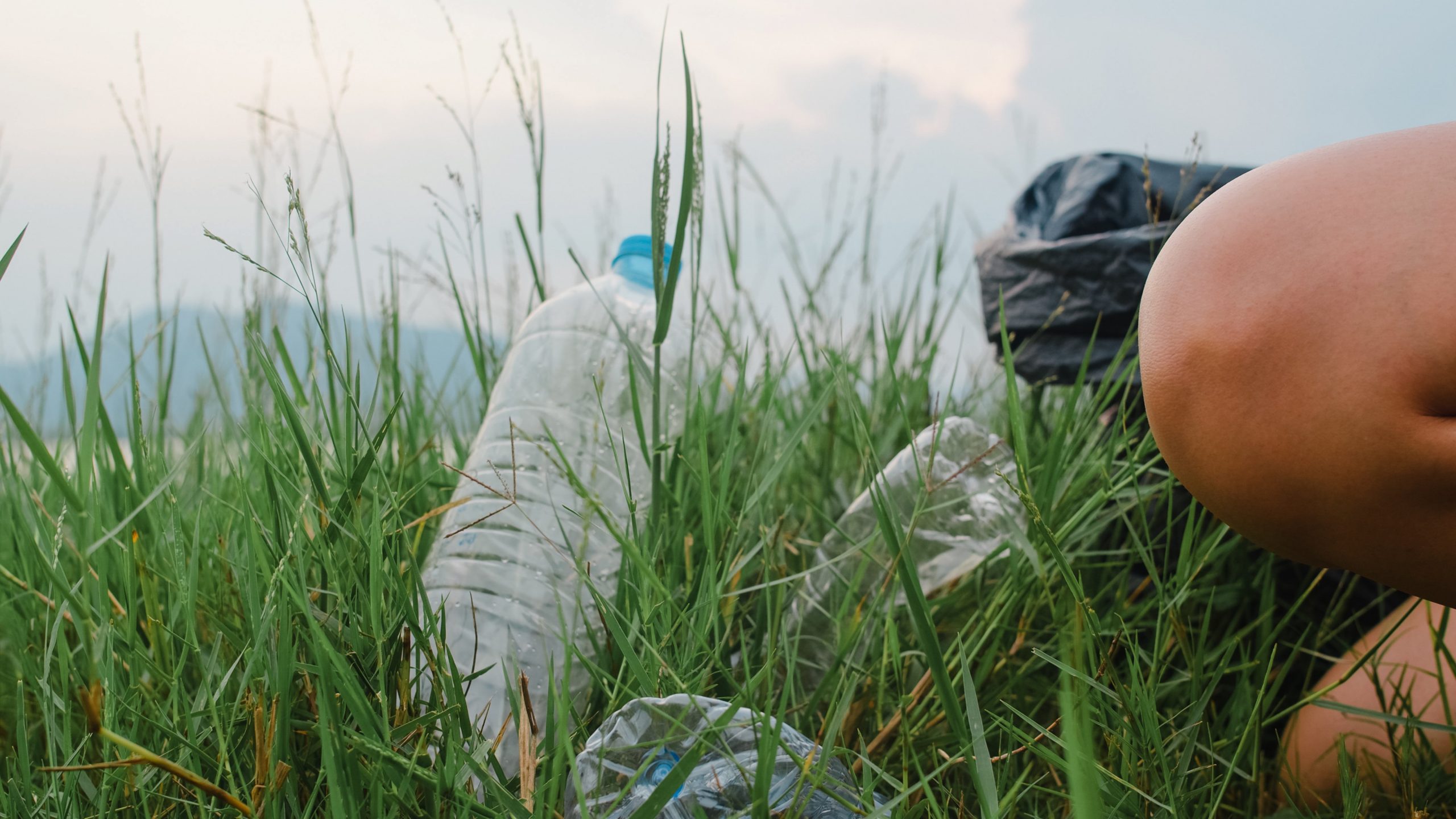
Polyethylene is one of the most widely used plastics in the world. It appears in shopping bags, shrink wrap, food packaging, detergent bottles and countless other products. It is cheap, light, durable and easy to process. Those same strengths also help explain why polyethylene waste has become such a stubborn environmental problem. Once it is discarded, the material is hard to collect cleanly, difficult to sort at scale and often not worth enough money to justify complex recycling. A recent study from Northwestern University points to a different idea: instead of trying to turn used polyethylene back into more polyethylene, convert it into molecules that industry already needs for soaps, detergents, lubricants and related products.
The work matters because it aims at a long-standing weak point in plastics recycling. Mechanical recycling works best when a plastic stream is clean, sorted and not heavily degraded. Polyethylene films and mixed household waste rarely meet that standard. Chemical recycling can handle harder streams, but many existing methods rely on high temperatures and often generate broad, messy mixtures that need costly downstream refining. The Northwestern team reported a more selective upcycling concept, one designed to preserve more of the value already present in the plastic’s carbon framework rather than reducing it to low-value fuel-like products.
Why polyethylene is such a difficult recycling target
On paper, polyethylene looks simple. Its chains are built mostly from carbon and hydrogen, repeated again and again. In practice, that simplicity is exactly the challenge. The carbon-carbon and carbon-hydrogen bonds in polyethylene are relatively nonreactive, which is why the plastic survives water, sunlight for a time and day-to-day wear. But it also means chemists must work hard to break or modify those chains in controlled ways.
That challenge has shaped the economics of recycling. When polyethylene is mechanically recycled, it is usually melted and remade into products with lower performance requirements. This is useful and should remain an important part of waste management. But repeated heating and processing can reduce properties. Thin films, multilayer structures, food contamination, pigments and additives can all make the stream less attractive. As a result, large amounts of polyethylene still end up in landfill, incineration, or the environment.
For years, researchers have asked a central question: can polyethylene be converted into something more valuable than the plastic waste itself? If the answer is yes, that higher value could help pay for collection, sorting and processing. That is the economic logic behind the Northwestern study.
What the Northwestern team set out to do
The researchers focused on upcycling, not simply recycling. In an upcycling strategy, waste is transformed into a product with equal or greater value. For polyethylene, that means avoiding the common trap of turning a useful long-chain material into a low-value hydrocarbon mixture. The Northwestern approach instead sought to selectively alter the polymer so it becomes a feedstock for chemicals already used in large industrial markets.
In broad terms, the team showed that polyethylene can be converted into oxygen-containing molecules that are useful intermediates for surfactants and related materials. Surfactants are the active ingredients that help soaps and detergents lift grease and mix oil with water. They are also used in cosmetics, coatings, agricultural formulations, household cleaners and many industrial processes. This is an important point: the target market is not a niche lab curiosity. It is a massive and established chemical sector.
The scientific idea behind the work is to add useful chemical functionality to pieces of the polyethylene chain. Instead of treating the waste polymer as something to destroy completely, the process treats it as a carbon-rich starting material that can be edited. That framing is increasingly common in advanced recycling research. The goal is not just waste disposal. It is molecular redesign.
How the chemistry differs from traditional thermal cracking
Conventional thermal routes such as pyrolysis generally rely on high temperatures to crack long polymer chains into smaller hydrocarbons. These processes can be useful, especially for difficult plastic mixtures, but they often produce a wide distribution of products. That means more separation, more purification and sometimes a business case tied closely to volatile fuel markets. If the output is mainly oil-like material, the overall value can be limited.
The Northwestern strategy aims to be more selective. Rather than fully random cracking, it introduces oxygen-containing functional groups and creates product families that are better aligned with specialty and performance chemicals. In simple terms, the chemistry tries to guide the breakdown so that the carbon atoms from waste polyethylene land in more useful places.
That difference is important for polymer and recycling professionals. Selectivity is often what separates an interesting reaction from a scalable manufacturing process. The more narrowly a process can define its output, the easier it becomes to model economics, product quality, purification needs and downstream formulation. A detergent ingredient stream is far more attractive than a broad and unpredictable hydrocarbon soup.
Why surfactants are a smart target
Target selection is one of the strongest features of this work. Surfactants are a logical destination for polyethylene-derived molecules because both involve long hydrocarbon chains. In a surfactant, one part of the molecule is attracted to oils and greases, while another part is attracted to water. That amphiphilic structure is what makes cleaning, emulsification and dispersion possible.
Polyethylene already offers the hydrocarbon-rich portion of that architecture. If chemists can selectively shorten, oxidize and functionalize the polymer chains, they can generate intermediates that fit naturally into surfactant chemistry. That means the waste plastic is not being forced into an unnatural application. Its original hydrocarbon character is being redirected into a product class that benefits from similar molecular features.
From an industrial standpoint, that matters because it can improve atom efficiency and value retention. The more of the original polymer chain that remains useful in the final product, the stronger the upcycling proposition becomes. This is one reason many experts see chemical upcycling as more promising when it targets lubricants, waxes, surfactants and specialty monomers, rather than just fuels.
What makes the study notable for the plastics industry
The research stands out for several reasons:
- It focuses on a very common waste plastic. Polyethylene is not an obscure specialty polymer. Any credible solution for it has obvious real-world relevance.
- It targets higher-value outputs. Detergent and surfactant ingredients usually command better economics than fuel-range products.
- It supports the idea of diversified recycling. Not every plastic stream should go through the same pathway. Clean polyethylene may still be best handled mechanically, while contaminated or low-grade streams could be candidates for chemical upcycling.
- It reinforces the link between polymer science and commodity chemistry. Waste plastics are increasingly being viewed as alternative carbon feedstocks for the broader chemical industry.
That last point may be the most important. For decades, plastics were treated mainly as end-use materials. Now researchers are also treating them as chemical inventories. A polyethylene bag is not just a bag after use. It is a concentrated store of carbon and hydrogen that might be repurposed, if chemistry and economics line up.
Still a laboratory advance, not a finished recycling system
As promising as the study is, it would be wrong to present it as a complete solution to polyethylene waste. The work is best understood as a strong laboratory demonstration with clear industrial relevance. Several major questions remain before any such approach could become a large commercial technology.
First, feedstock quality matters. Real-world polyethylene waste is not pure. It contains dyes, fillers, stabilizers, antioxidants, inks, food residues, paper labels and traces of other polymers. A process that works on model materials or carefully prepared waste still has to prove itself against the variability of municipal and post-industrial streams.
Second, process integration matters. Even if the core chemistry is efficient, a plant would still need shredding, washing, pretreatment, catalyst handling, product separation and quality control. Many recycling technologies struggle not because the chemistry fails, but because the total system becomes too expensive or too complex when all unit operations are counted.
Third, environmental performance must be measured carefully. A new route is only compelling if it reduces emissions, energy use, or resource demand compared with the alternatives. That requires full life-cycle assessment, not just reaction yields. If a process uses costly reagents, heavy solvent loads, or energy-intensive purification, the sustainability case can weaken quickly.
How this fits with mechanical recycling and reuse
One of the most useful ways to interpret the Northwestern work is as part of a portfolio approach to plastics management. Mechanical recycling should remain the first choice for clean and well-sorted polyethylene streams because it usually preserves material value with less energy input. Reuse systems, better package design and reduction of unnecessary plastic use are also essential. Chemical upcycling is not a replacement for those strategies.
Where advanced chemistry may add the most value is in the streams that are poorly served today: thin films, mixed flexible packaging, degraded polyethylene, or waste that no longer meets the quality demands for closed-loop remelting. If those streams can be upgraded into specialty chemicals, the overall recycling map becomes more complete.
This is a key point for policy and industry. Too often, recycling debates are framed as mechanical versus chemical, as if one must defeat the other. In reality, different waste streams need different solutions. The most practical future is likely to combine reduction, redesign, reuse, mechanical recycling, solvent-based purification where appropriate and selective chemical conversion for difficult fractions.
Why polymer scientists will watch the next phase closely
For researchers in polymers and industrial chemistry, the Northwestern report raises a set of concrete follow-up questions. Can the process handle a wider variety of polyethylene grades, including low-density and linear low-density films? How tolerant is it to additives? Can product selectivity remain high when the feedstock changes? What are the best catalyst systems and reaction conditions for scale? Can the outputs be tuned toward different surfactant families or wax formulations? And perhaps most importantly, what is the true cost of the full process on a per-kilogram basis?
These are not minor details. They determine whether the chemistry remains a clever publication or evolves into a manufacturing platform. The history of polymer recycling is full of elegant lab reactions that struggled in the presence of dirty inputs and commodity-price pressure. At the same time, real progress often begins exactly this way: with a proof that a supposedly low-value waste stream can be redirected toward a product class that industry already understands and already buys.
Another reason this work will attract attention is its broader conceptual message. It supports a growing trend in polymer science toward molecularly informed circularity. Instead of asking only how to collect waste, researchers are asking what the molecular structure of each waste stream makes possible. Polyethylene, because it is so hydrocarbon-rich, may be especially well suited to routes that lead into detergents, lubricants and waxes. PET, by contrast, may be better suited to monomer recovery. Polyurethanes may need entirely different chemistry again. Circularity is becoming polymer-specific.
The bigger picture for plastics upcycling
The Northwestern study arrives at a time when the plastics sector is under pressure from several directions at once: tougher policy scrutiny, rising expectations around recycled content, growing public concern over waste leakage and continued demand for low-cost packaging materials. In that environment, technologies that create stronger economics for waste recovery will draw serious interest.
That does not mean every upcycling claim should be accepted uncritically. The field has sometimes moved too quickly from promising chemistry to oversized commercial promises. The strongest path forward is disciplined: show clear selectivity, use realistic waste streams, publish rigorous mass balances, compare against existing routes and be honest about where the process fits best. By that standard, the Northwestern work is encouraging because it highlights a credible value proposition without pretending that all plastic waste can be solved by one reaction.
If the concept continues to develop, its significance could extend beyond detergents. Once a reliable platform exists for converting polyethylene into oxygenated intermediates, other product families may become possible as well. That could include lubricants, coatings ingredients, specialty waxes, or precursors for other functional materials. In other words, the real breakthrough may be less about one final product and more about opening a broader chemical toolbox for one of the world’s most abundant waste polymers.
What to watch next
In the near term, the most important signals will be scale-up data, tolerance to contaminated feedstocks and transparent sustainability analysis. Partnerships with detergent makers, chemical producers, or waste-management companies would also be meaningful because they would test whether the chemistry meets real market specifications. For polymer engineers, reactor design and product separation may prove just as decisive as catalyst performance.
Even at this early stage, the message is clear. Polyethylene waste does not have to be viewed only as a disposal problem or a low-grade fuel source. With careful chemistry, it can become a feedstock for useful and higher-value molecules. That shift in perspective is one of the most important changes now underway in recycling science.
Northwestern University’s report does not end the polyethylene waste problem. But it offers a practical and scientifically grounded reminder that better outcomes may come not only from collecting more plastic, but from thinking more creatively about what waste polymers can become. For a field searching for routes that are both technically credible and economically meaningful, that is very real progress.
Related reading
More journal reading and science coverage connected to this topic.
Enzymatic PET recycling moves closer to industrial reality
For years, chemical recycling has been discussed as a possible answer to one of plastics manufacturing's hardest problems: how to recover value from waste…

DEVELOPMENT OF A RUBBER-BASED PRODUCT USING A MIXTURE EXPERIMENT: A CHALLENGING CASE STUDY
Title: DEVELOPMENT OF A RUBBER-BASED PRODUCT USING A MIXTURE EXPERIMENT: A CHALLENGING CASE STUDY Page Range: p.123-150 Author(s): Yahya Kaya; Piepel G F; Erdal…
EFFECT OF FLY ASH AS FILLER IN RUBBER – A COMPREHENSIVE STUDY OF THE VULCANISATE PROPERTIES OF STYRENE-BUTADIENE RUBBER COMPOUNDS
Title: EFFECT OF FLY ASH AS FILLER IN RUBBER - A COMPREHENSIVE STUDY OF THE VULCANISATE PROPERTIES OF STYRENE-BUTADIENE RUBBER COMPOUNDS Page Range: p.151-168…