
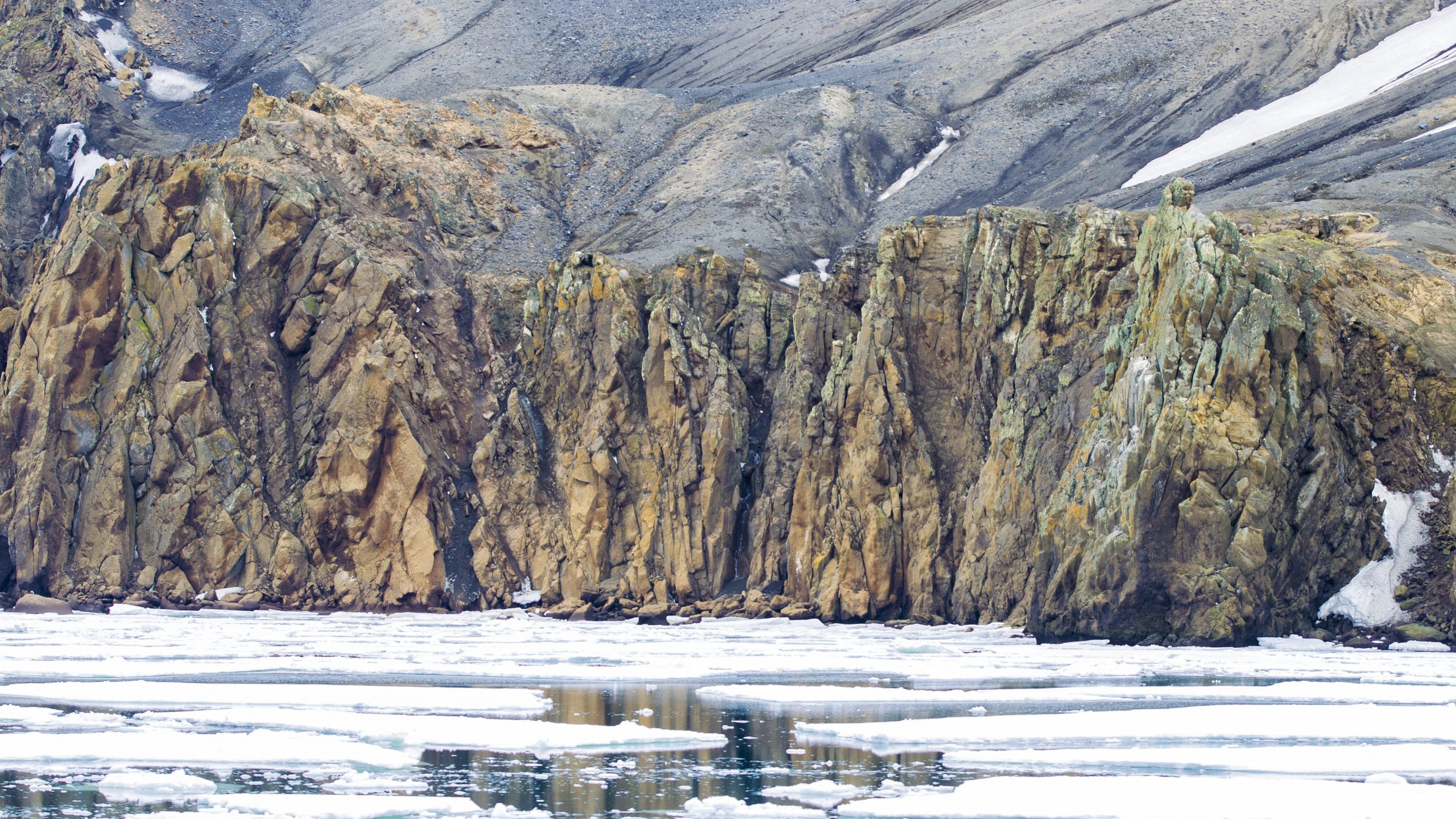
Scientists have reported one of the clearest signs yet that Antarctica’s Thwaites Glacier is not just melting and thinning, but also failing in ways that can be tracked through seismic signals. In a new study posted as a preprint and due to appear in Geophysical Research Letters, researchers identified 362 glacial earthquakes at Thwaites between 2010 and 2023. Most of those events were clustered near the glacier’s ocean-facing edge, where ice breaks off into the sea.
That matters because Thwaites is not an ordinary glacier. It is one of the largest and most vulnerable ice systems in West Antarctica and it is often called the Doomsday Glacier because of its potential contribution to sea-level rise if it were to retreat rapidly over long timescales. A complete collapse of the glacier and the ice it holds back would have major global consequences, although scientists do not expect such a full collapse to happen all at once.
The new earthquake catalog does not mean that disaster is imminent. But it does show that the glacier is highly dynamic at its marine front, where contact with the ocean, iceberg calving, cracking and mechanical failure all interact. For materials scientists and fracture researchers, that makes Thwaites a remarkable natural laboratory: a giant body of polycrystalline ice behaving like a stressed, damaged and evolving material under changing temperature and loading conditions.
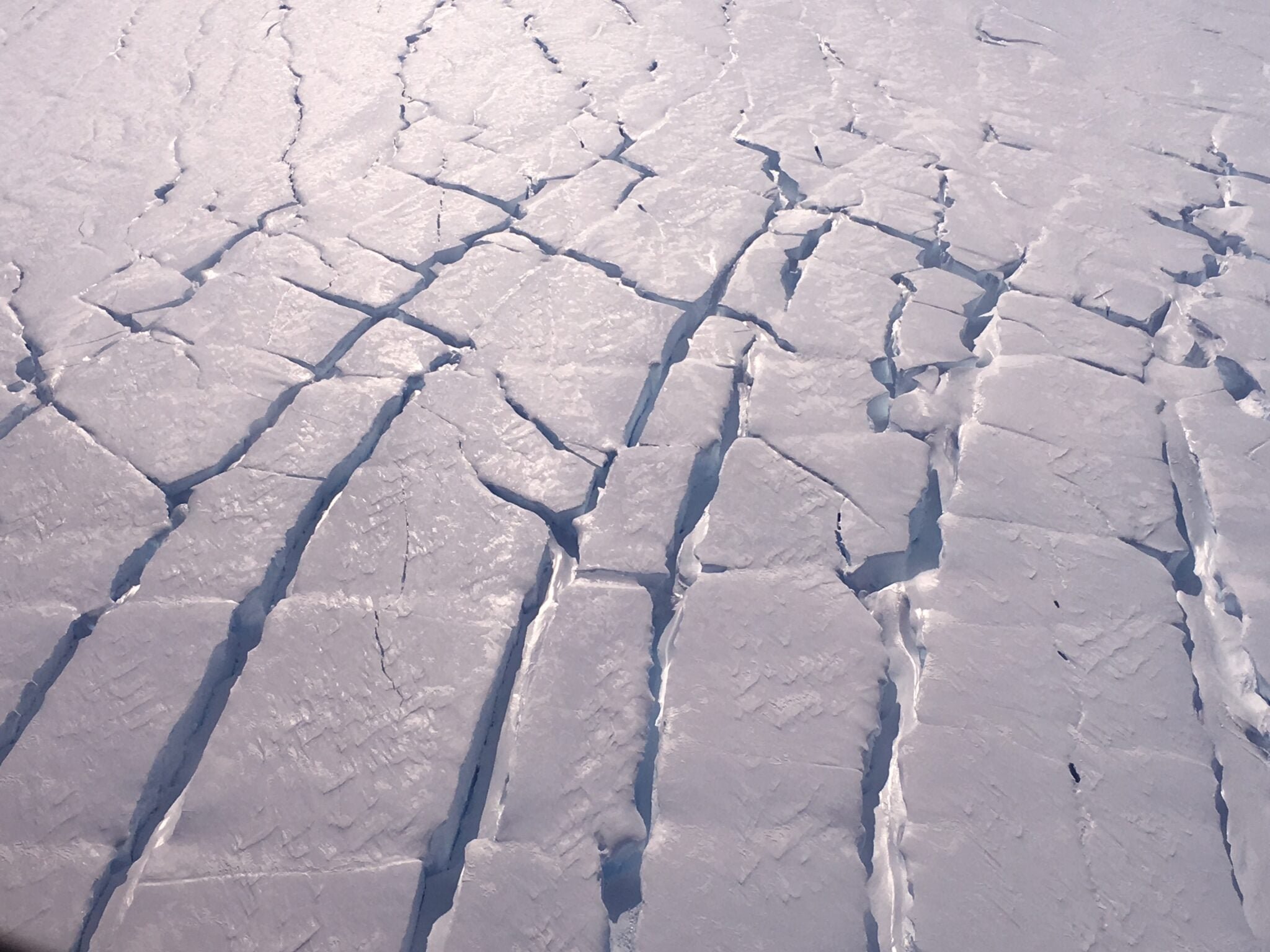
Cracks in the ice of Thwaites Glacier viewed from the air in 2020.
What makes a glacial earthquake different from an ordinary earthquake?
Most people think of earthquakes as tectonic events caused by faults in rock. Glacial earthquakes are different. They are seismic events generated by the movement and break-up of ice, especially where large outlet glaciers meet the ocean.
The phenomenon was first recognized in the Northern Hemisphere more than 20 years ago. A landmark paper in Science showed that some very large seismic signals from Greenland were not tectonic quakes at all, but were linked to glacier motion and iceberg calving. Since then, glacial earthquakes have become an important way to study the mechanical behavior of ice sheets.
One common mechanism is the sudden detachment and rotation of an enormous iceberg. When a large block of ice calves from a glacier front and begins to capsize in the water, it can apply a strong force to the glacier and the surrounding ocean. That force generates seismic waves that can be detected far away. In effect, the glacier “rings” when a major calving event occurs.
These events are useful because satellites can show where glaciers are changing, but seismology can reveal when rapid fracture and calving happen, sometimes with very high timing precision. Seismic records therefore provide a way to monitor ice failure in near real time and over long historical periods.
Until recently, however, only a small number of glacial earthquakes had been confirmed in Antarctica. That made the continent seem quieter than Greenland from a seismic point of view, even though Antarctica contains vastly larger ice masses. The new findings suggest that part of the difference may have been one of detection rather than absence.
What the new study found at Thwaites
The new work reports evidence for hundreds of Antarctic glacial earthquakes over a 13-year period, with a strong concentration at Thwaites Glacier. Of the 362 events identified, 245 were located near the marine end of Thwaites. According to the study, most of those are likely linked to iceberg capsizing and related calving processes.
That geographic clustering is important. It places the seismic activity where Thwaites is in direct interaction with the ocean, rather than deep in the stable interior of the ice sheet. The result fits with what glaciologists already know about Thwaites: its floating and near-floating margins are under severe stress, its grounding zone is changing and warm ocean water has been implicated in ongoing ice loss beneath parts of the glacier.
The preprint is available through ESS Open Archive. While the paper focuses on event detection and location, its broader value lies in showing that Antarctic seismic records contain a richer history of glacier failure than many researchers appreciated. A fuller event inventory can help scientists compare calving styles, identify periods of heightened activity and test links between seismicity, ocean forcing and ice-front geometry.
Just as important, the results suggest that Antarctic glaciers may produce more detectable mechanical signals as they destabilize. That does not automatically translate into faster sea-level rise on short timescales, but it does add another line of evidence that the glacier terminus is highly active and mechanically complex.
Independent climate scientists and communicators also highlighted the finding because it connects a vivid public image of Thwaites with a measurable physical process: the glacier is not simply shrinking quietly. It is breaking, shedding icebergs and generating forceful seismic events that can be tracked over time.
Why Thwaites Glacier attracts so much attention
Thwaites drains a large part of West Antarctica into the Amundsen Sea. It is especially significant because much of the ice in this region rests on bedrock that deepens inland. That geometry can make marine ice-sheet retreat hard to stop once it gets underway, since the retreating grounding line can expose thicker ice to the ocean.
The glacier also acts as a partial buttress within the wider ice-sheet system. If Thwaites retreats and thins enough, it can reduce resistance for nearby ice, potentially amplifying losses beyond its own basin. This is one reason scientists watch it so closely with aircraft, satellites, ocean instruments, autonomous underwater vehicles and field campaigns.
The nickname Doomsday Glacier captures public attention, but it can also oversimplify the science. The realistic concern is not that Thwaites will vanish overnight. The concern is that ongoing thinning, grounding-line retreat, calving and structural weakening may push the glacier toward faster long-term mass loss, with consequences for global coastlines.
In that context, glacial earthquakes matter because they are direct evidence of abrupt mechanical events. A glacier can lose mass slowly through melt, but it can also lose it in sudden chunks through fracture and calving. When the latter process accelerates, seismicity can become a valuable diagnostic.
Why this is also a materials story
Although the headline is about earthquakes, the underlying science is deeply tied to materials behavior. Glacier ice is a complex solid. It can deform slowly like a viscous material over long periods, yet it can also fail suddenly in a brittle way when stresses are concentrated. Its response depends on temperature, grain structure, impurities, cracks, water content, loading rate and confinement.
Thwaites is therefore a large-scale example of competing deformation modes in a natural material. Inland, the ice may creep over years and decades. Near the front, especially where crevasses open and icebergs detach, brittle fracture becomes more prominent. The seismic signals detected in the study are effectively a record of abrupt failure episodes.
For readers in polymer and composite fields, there is a familiar theme here: materials often do not fail in a single uniform way. They accumulate damage, develop local weak zones and respond differently across time and length scales. In ice, as in many engineering materials, the transition from distributed deformation to catastrophic cracking is crucial.
There is also the role of interfaces. Thwaites is influenced by the contact between ice and ocean water, by the geometry where grounded ice begins to float and by fracture planes that may be lubricated or widened by meltwater. Interface-driven failure is a classic problem across materials science, whether one is studying coatings, laminates, composites, or cryogenic solids.
Finally, the study highlights the importance of sensing. In industrial settings, engineers use acoustic emission and vibration monitoring to detect crack growth and structural failure before total breakdown. Seismology plays a similar role for glaciers at planetary scale. Each glacial earthquake is a detectable signature of energy release from material failure.
What the earthquake pattern may be telling researchers
The concentration of events near the marine end of Thwaites strongly suggests that calving is the dominant source for many of the detected earthquakes. When large icebergs break free and rotate, they can create forces big enough to produce distinct seismic signals. That interpretation matches observations from Greenland, where many glacial earthquakes have been linked to large calving events.
But not every signal has to come from the exact same mechanism. Some may reflect changes in stress around the grounding zone, stick-slip motion at the ice-bed interface, or rapid fracture within heavily crevassed ice. Distinguishing among those possibilities will require combining seismic records with satellite imagery, ice-speed measurements and ocean observations.
This is where long time series become valuable. If researchers can match bursts of seismicity to known periods of retreat, thinning, or major calving-front reorganization, they can begin to use earthquakes as a proxy for structural change. Over time, that could improve how models represent episodic ice loss, which remains one of the harder parts of sea-level forecasting.
The social-media discussion around the work reflects a wider shift in cryosphere science: increasingly, glaciers are being interpreted not only as climate indicators but also as dynamic mechanical systems. The climate signal sets the background conditions, but the immediate expression at the ice front can be sudden, nonlinear and noisy.
What the study does and does not mean
It is important not to overread the result. A higher number of detected glacial earthquakes does not mean that Thwaites is on the verge of an immediate full collapse. Calving is a normal process for marine-terminating glaciers and seismic detection itself does not measure total mass loss.
At the same time, the findings should not be dismissed as routine. Thwaites is already one of the world’s most closely watched glaciers because multiple lines of evidence point to ongoing destabilization. A dense record of glacial earthquakes adds to that picture by documenting how active and energetic the glacier front has been over more than a decade.
Another caution is that catalog quality depends on station coverage, signal processing and location uncertainty. Antarctica is remote, instrument networks are sparse compared with many populated regions and some smaller events will have been missed. Even so, the detection of hundreds of events is a strong indication that the phenomenon is real and significant.
What researchers will want to do next
The obvious next step is to connect individual earthquakes to observed calving events, iceberg trajectories and local glacier geometry. That would help confirm which seismic signatures correspond to which physical processes.
Researchers will also want to compare Thwaites with other Antarctic outlet glaciers. If similar event catalogs can be built elsewhere, scientists may be able to identify which glacier types are most prone to seismic calving and whether seismicity changes as marine instability advances.
Better integration across methods will be essential. Satellite altimetry can measure thinning. Radar and optical imagery can map fractures and front retreat. Ocean data can show where warm water is reaching the ice. Seismology can supply the timing of sudden failure. Put together, those tools offer a more complete picture than any one method alone.
- Key finding: 362 Antarctic glacial earthquakes were identified between 2010 and 2023, with 245 near the marine end of Thwaites Glacier.
- Likely cause: many events are consistent with large iceberg calving and capsizing at the glacier front.
- Why it matters: Thwaites is a major contributor to potential future sea-level rise and a focal point for ice-sheet instability research.
- Why it matters for materials science: the quakes record abrupt fracture, interface failure and damage evolution in a large natural ice body.
- Main caution: increased seismic activity is a warning sign of active mechanical change, not proof of immediate total collapse.
In short, the new study turns seismic noise into a clearer narrative about one of Antarctica’s most consequential glaciers. Thwaites is not simply melting at the margins. It is cracking, calving and releasing energy in bursts that can now be counted and mapped. For climate science, that improves monitoring of a glacier with global importance. For materials science, it is a striking reminder that brittle failure, damage accumulation and interface-driven instability are not limited to the lab or the factory floor. They can reshape entire coastlines.
Related reading
More journal reading and science coverage connected to this topic.

A novel approach for fabricating poly-l-lactide materials by onestep bulk polymerization
Title: A novel approach for fabricating poly-l-lactide materials by onestep bulk polymerization Page Range: p.249-254 Author(s): Zhiyuan Peng; Zhiping Li; Fan Zhang; Xiaochun Peng…
Effect of filler on the mechanical and dynamic properties of impact energy-absorbing materials
Title: Effect of filler on the mechanical and dynamic properties of impact energy-absorbing materials Page Range: p.1-6 Author(s): Frank M; Drdlova M; Vladan Prachar;…
Effects of fluorinated silane coupling agent on properties of microcapsules for self-healing materials
Title: Effects of fluorinated silane coupling agent on properties of microcapsules for self-healing materials Page Range: p.21-26 Author(s): Xiulan Cai; Datian Fu; Ailan Qu…