
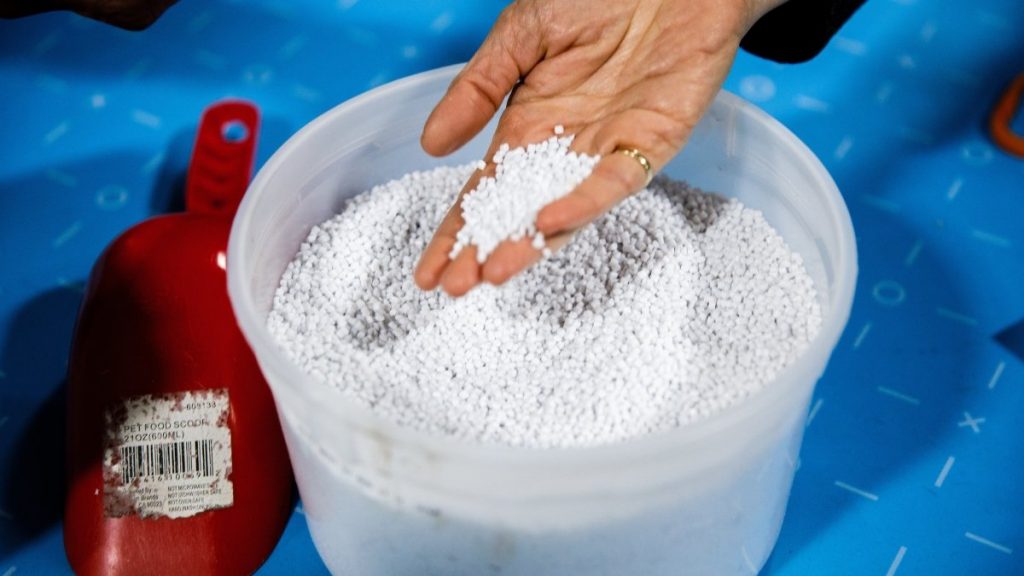
A plastic that can be tough, durable and chemically stable in use, yet still be taken back to its original building blocks when its job is finished, has long been a goal in polymer science. One of the clearest examples of that idea is poly(diketoenamine), or PDK, a class of polymers developed at Lawrence Berkeley National Laboratory. The chemistry has attracted sustained attention because it tackles one of the hardest problems in plastics recycling: what to do with materials that are designed not to melt, not to dissolve and not to break down during service.
Recent work around the PDK platform has helped shift the conversation from “can this be done?” to “where can it be used first and what would it take to scale it responsibly?” That is an important change. In the plastics sector, many recycling discussions still focus on improving collection, sorting, or mechanical reprocessing. Those steps matter, but they do not solve everything. Some polymer products lose too much performance after remelting. Others contain additives, pigments, fillers and reinforcing fibers that make conventional recycling inefficient or uneconomic. Thermosets are especially difficult.
PDK is interesting because it approaches the problem at the molecular-design stage. Instead of making a polymer first and worrying about end-of-life later, the material is built so that its key bonds can be reversed under controlled chemical conditions. In simple terms, the same chemistry that locks the material together can also unlock it. That is why many researchers see PDK and related designed-for-deconstruction polymers as a serious part of the future circular economy for plastics.
Why hard-to-recycle plastics remain a major gap
Much public discussion about recycling centers on bottles, films and packaging. Those are highly visible products and they matter because they are produced in large volumes. But many of the most technically challenging polymers are used in places the average consumer rarely notices: coatings, adhesives, electronic encapsulants, fiber-reinforced parts, foams, automotive components, aerospace structures and durable industrial goods.
These materials are often based on thermosets. Unlike common thermoplastics, which soften and flow when reheated, thermosets form permanent network structures during curing. That crosslinked structure gives them heat resistance, dimensional stability, solvent resistance and strength. It also makes them difficult to recycle by ordinary melting and remolding.
In practice, that means thermoset-rich waste streams are often landfilled, incinerated, or at best downcycled into lower-value fillers. Even when a part contains expensive material, the cost of separating layers, removing additives, or recovering clean polymer value can be too high. This is one reason the industry is looking beyond mechanical recycling and toward selective depolymerization, dissolution methods, dynamic covalent networks and new monomer chemistries.
Berkeley Lab’s PDK work fits directly into that challenge. It is not a universal answer for all plastics. It does, however, offer a strong demonstration that a network polymer can be designed for high-value recovery rather than end-of-life disposal.
What makes PDK different
PDK stands for poly(diketoenamine). The key idea is that the polymer network contains diketoenamine linkages that are stable during use but can be cleaved in strongly acidic conditions. When that happens, the polymer does not simply fragment into a messy mixture of degraded chains. Instead, the chemistry can return the material to its original monomer components, which can then be purified and used again.
That distinction matters. In many recycling systems, each loop reduces material quality. Molecular weight can fall, contaminants build up and color or additive packages limit what the recycled output can become. PDK was developed to avoid that trap by enabling closed-loop chemical recycling at the monomer level.
Another important feature of the original Berkeley Lab reports was that additives could be separated from the monomers during recovery. That point is easy to overlook, but industrially it is huge. Commercial plastics are rarely neat polymers. They contain stabilizers, plasticizers, dyes, flame retardants, impact modifiers, fillers and processing aids. Those ingredients are often essential in service and highly problematic at end of life. A recycling chemistry that can tolerate complex formulations and still recover valuable feedstock has a real advantage over systems that work only on pure, clean, lab-made samples.
In other words, PDK is not just about reversibility. It is about reversibility in a realistic materials environment.
Why the recent progress matters
The most important recent development is not one single headline result. It is the steady broadening of the PDK concept from a clever molecular demonstration into a more practical materials platform. Researchers have continued exploring how the chemistry performs across different formulations, processing routes and property targets. That includes work on mechanical robustness, tougher networks, composite possibilities and the economics of feedstock selection and recovery.
For polymer scientists, that transition is a familiar one. A new polymer system usually begins with proof of concept: make it, characterize it, show a unique feature and publish the chemistry. The harder second phase is application engineering. Can it be processed on useful timescales? Can it survive real service conditions? Can it be molded, bonded, or reinforced? How sensitive is it to moisture, heat, ultraviolet light, or impurities? Can recovery be done with reasonable solvent and energy use? Can the recovered monomers be repolymerized repeatedly without drift in quality?
PDK has stayed relevant because it continues to score well on the questions that matter most for circularity. The polymer is not being promoted as magic. Rather, it is being treated as a serious case study in what designing for recyclability from the start actually looks like in polymer chemistry.
That is a significant shift for industry. For years, many sustainability efforts tried to fit old materials into improved waste systems. PDK turns that model around and asks whether some materials should be invented differently in the first place.
Where PDK could make the biggest early impact
Not every polymer innovation needs to start in mass packaging. In fact, many advanced materials succeed first in high-value, lower-volume sectors where performance and recovery are both important. That may be the natural path for PDK.
Potential early-use areas include durable goods, electronics housings, adhesives, specialty coatings and some composite-rich applications where the economics of reclaiming value are stronger than they are for commodity packaging. If a manufacturer can recover expensive monomers, reduce hazardous waste and potentially reclaim embedded additives or reinforcements, the business case becomes more attractive.
There is also a strategic angle. Regulations and corporate targets increasingly emphasize traceability, recycled content and end-of-life accountability. A material platform that is intentionally compatible with take-back and depolymerization may help companies move beyond broad sustainability claims toward a more measurable circular model.
That said, the first successful applications are unlikely to be the most price-sensitive ones. Commodity plastics compete on cost at enormous scale. A newer chemistry has to earn its place either through performance, regulation-driven value, recovery economics, or all three.
What PDK does not solve by itself
It is important to keep the science in proportion. PDK does not make all plastics recyclable. It does not remove the need for collection, sorting, logistics, safe chemical handling, or life-cycle analysis. And it does not eliminate the environmental footprint of material production.
The depolymerization step depends on controlled chemical treatment, commonly discussed in the context of strong acid. That means process design, equipment choice, worker safety, chemical recovery and waste minimization all matter. A polymer that can be chemically recycled in principle is only sustainable in practice if the entire system around it is well engineered.
There is also the question of infrastructure compatibility. Today’s plastics economy is built around mature feedstocks, processing tools, qualification methods and supply chains. Any new polymer system must fit into at least some of that industrial reality. Even a strong lab result can struggle if the manufacturing route is too specialized or if end-of-life handling requires a separate stream that no one is ready to collect.
That is why many researchers now stress that the circular economy will require multiple recycling technologies, not a single winner. Mechanical recycling will remain essential where it works well. Solvent-based purification may be useful for some streams. Depolymerization will fit others. Biobased polymers will matter in some markets, but not all. Designed-for-recycling materials like PDK add another important tool to that mix.
A useful comparison: thermoplastics versus circular thermosets
One reason PDK gets attention is that it highlights a blind spot in plastics policy. Most recycling systems were developed around thermoplastics because those materials can often be remelted. That makes sense from an infrastructure standpoint, but it can leave more difficult materials behind.
Thermosets are often chosen precisely because they outperform thermoplastics in demanding environments. If society wants those functions, then it also needs better end-of-life options for them. PDK suggests a possible route: preserve network performance during use, but build in a chemical trigger for later recovery.
This concept also connects with wider research on vitrimers, dynamic covalent chemistry, reversible crosslinks and self-healing materials. The field is moving toward polymers that are less “one-way” than traditional networks. Some systems are reprocessable through bond exchange reactions. Others are fully depolymerizable to monomers. The exact chemistry differs, but the design philosophy is similar: make the material durable in service and manageable after use.
For industrial scientists, that is not just elegant chemistry. It is a response to regulation, carbon pressure, waste costs and resource security.
The technical questions researchers and companies still need to answer
If PDK is to become more than a showcase chemistry, several issues will need continued work.
- Cost of monomers and synthesis: Specialty monomers can limit adoption. Broader feedstock options and simpler synthesis routes improve the chance of scale-up.
- Processing windows: Manufacturers need materials that cure, mold, or coat reliably on practical timescales.
- Property range: Real products need toughness, impact resistance, thermal stability and environmental durability tailored to each application.
- Recovery process efficiency: Depolymerization must be selective, scalable and compatible with solvent and reagent recovery.
- Additive management: Industrial products contain complex formulations. The chemistry must keep working when pigments, fillers and stabilizers are present.
- Life-cycle performance: A closed-loop chemistry is only valuable if its total environmental footprint compares well with the incumbent material and disposal route.
- Collection systems: Materials designed for depolymerization still need a path back from the user to the recovery process.
None of these are trivial. But they are the right questions to be asking. In polymer innovation, the promising sign is not that every issue is already solved. It is that the material has matured enough for the field to focus on the practical barriers rather than the basic concept.
Why this matters beyond one polymer family
The deeper significance of Berkeley Lab’s PDK work is that it has helped reset expectations for what “recyclable plastic” can mean. For many years, recyclability was often treated as a post-use sorting issue. The new generation of polymer chemistry shows that recyclability can be embedded directly into molecular architecture.
That changes how chemists think about performance. A polymer no longer has to be judged only by strength, modulus, glass-transition temperature, barrier properties, or chemical resistance. Increasingly, it must also be judged by how intelligently it exits service.
That perspective is spreading across the field. Researchers are now more likely to ask whether a high-performance material can be disassembled, whether its monomers can be recovered selectively, whether its additives can be separated and whether its value can be preserved through multiple cycles. Those questions are becoming part of mainstream polymer design, not niche academic exercises.
PDK has been influential because it made that philosophy concrete. It provided a memorable example of a polymer system that was not merely “less bad” at end of life, but intentionally built for circular recovery.
What industry should watch next
Over the next few years, the key signals will likely come from application-specific validation rather than broad claims. Industry should watch for evidence that PDK-type materials can be integrated into real components, processed at useful scale, survive realistic environments and be depolymerized with acceptable economics and environmental performance.
Another important milestone will be whether recovery systems can be designed around concentrated, well-defined waste streams. That is often how new recycling technologies gain traction: not by solving the whole municipal waste problem at once, but by starting with controlled industrial or commercial streams where composition is known and collection is feasible.
If that happens, designed-for-recycling thermosets could become one of the more practical circular-materials stories in the polymer sector. They may not replace commodity polyolefins and they do not need to. Their value may lie in the places where existing recycling routes perform worst and where retained material value is highest.
The broader lesson is clear. The next generation of plastics will not be judged only by how well they perform on day one. They will be judged by whether chemists and manufacturers have planned for day 1,000 as well. PDK remains one of the clearest signs that this shift is underway.
For readers who want to follow the underlying research, Lawrence Berkeley National Laboratory has published updates on the PDK platform through its materials and sustainability programs and the original chemistry was reported in peer-reviewed literature. More information is available from Lawrence Berkeley National Laboratory and through the laboratory’s published work on chemically recyclable polymers.
Related reading
More journal reading and science coverage connected to this topic.

STUDY ON MECHANICAL PROPERTIES AND WATER ABSORPTION BEHAVIOUR OF WASTEPAPER FIBRE/RECYCLED POLYPROPYLENE COMPOSITES
Title: STUDY ON MECHANICAL PROPERTIES AND WATER ABSORPTION BEHAVIOUR OF WASTEPAPER FIBRE/RECYCLED POLYPROPYLENE COMPOSITES Page Range: p.395-402 Author(s): Zhang Xiaolin; Bo Xiangfeng; Wang Rumin…

ENVIRONMENT FRIENDLY COMPOSITES OF RECYCLED HARDWOOD FIBER REINFORCED POLYPROPYLENE
Title: ENVIRONMENT FRIENDLY COMPOSITES OF RECYCLED HARDWOOD FIBER REINFORCED POLYPROPYLENE Page Range: p.229-246 Author(s): Priyanka; Anshu Anjali Singh; Kishor Biswas Click Here to Download…